
Soil carbon dominates ACCU registrations in July
Of the 34 new projects, soil organic carbon (SOC) accounted for 21 of them. The latest monthly update by the Clean Energy Regulator also saw 90 projects earning a total just shy of 1.94 million ACCUs. Meanwhile, 11 projects - all of them SOC - were voluntarily revoked. See the latest projects here.

New registrations
July's tally of new registrations was the joint highest monthly total since September 2025. Of the 21 SOC projects, 12 were multiple projects on the same land title: nine at Moya Farm in South Australia, and three at Stonehaven in Queensland.
A periodic review by the Emissions Reduction Assurance Committee (ERAC) recommended several changes to the 2021 SOC (Estimation of soil organic carbon sequestration using measurement and models) method. These include an end to multiple projects on single land titles.
There are now 956 active soil projects, covering more than one million hectares of land. Despite its increasing prominence, only 53 SOC projects have earned ACCUs, with no fresh credits in July.
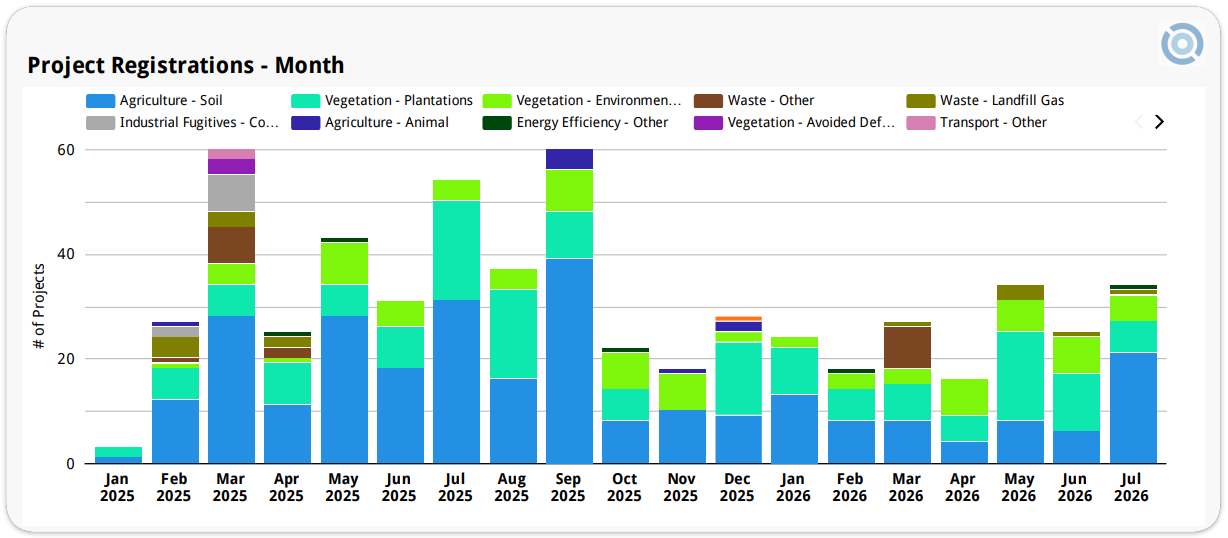
After soil, the next most popular method was plantation forestry, with six new projects, followed by environmental planting (5), energy efficiency (1) and landfill gas (1). Only two of the 34 projects opted for 100-year permanence.
South Australia had the most new projects (11), followed by New South Wales (7), Queensland (7), Victoria (5), Western Australia (3), and Tasmania (2). One project is sited in two states (New South Wales and Victoria).
In terms of proponents, AgriProve led with 13 new projects, followed by CarbonLink (3), APAC Natural Capital (3), and Precision Pastures (1).
To view ACCU statistics and trends head to Analytics Dashboard and create a free account to access additional pages.
Some of the new projects
APAC Jynoomah

ERF208863: View on Project Explorer
This is the largest of three new soil carbon projects, registered by proponent APAC Natural Capital. It covers just under 12,000, at this historic pastoral station of Jynoomah, in the Tambo area of central western Queensland.
The project aims to increase carbon in the soil by altering the stocking rate, duration, and intensity of grazing. These activities are specifically designed to promote soil vegetation cover, improve moisture retention, and improve overall soil health.
Another new soil project, APAC Ercildoune, managed by the same proponent, is also located near the town of Tambo. Interestingly, both pastoral stations have teddy bears named after them - Jynoomah Jasper and Ercildoune Eric. Locally-based Tambo Teddies is a community business which produces 100% woolen sheepskin bears.
Guinness Revegetation Project
ERF209395: View on Project Explorer
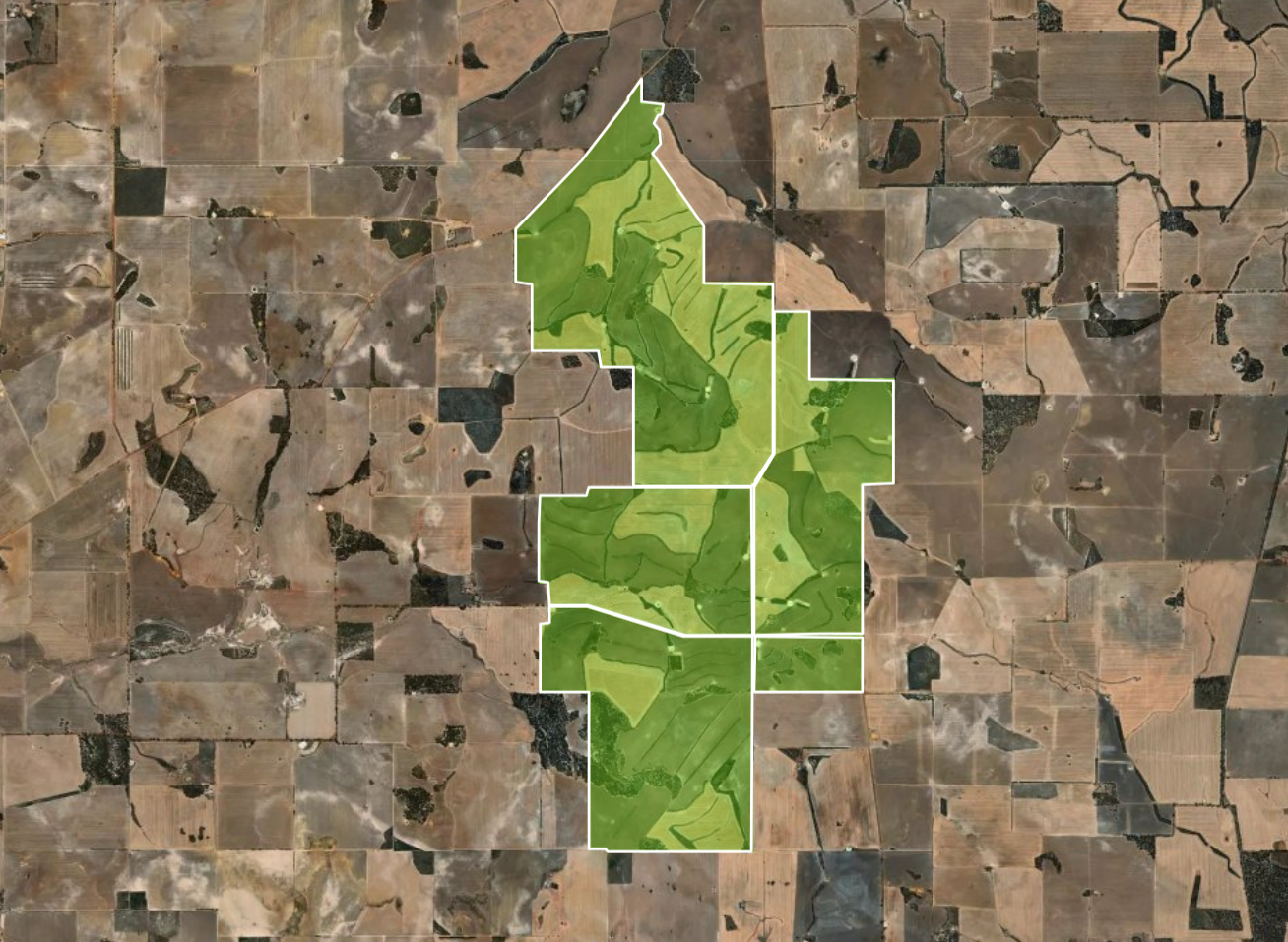
This environmental planting project in the wheatbelt of Western Australia, near the towns of Brookton and Corrigin, aims to establish a permanent mix of trees and shrubs which are native to the local area.
To meet requirements under the Reforestation by environmental or Mallee plantings-FullCAM method 2024, plantings are established at a typical density of at least 200 stems per hectare, to ensure that the vegetation can eventually achieve forest cover.
The project proponent, Kwongan Pty Ltd, is involved in developing innovative farming methods to sequester soil carbon, especially in sandy, low fertility soils. Its name is a Noongar Aboriginal word used to describe the highly biodiverse sandy heathlands and scrublands native to southwestern Australia.
Kwongan Pty Ltd is acting as trustee for RJ & CM Guinness Family Trust and RJ Guinness.
Western Treefarm Project WTP1C - Farleigh
ERF209335: View on Project Explorer
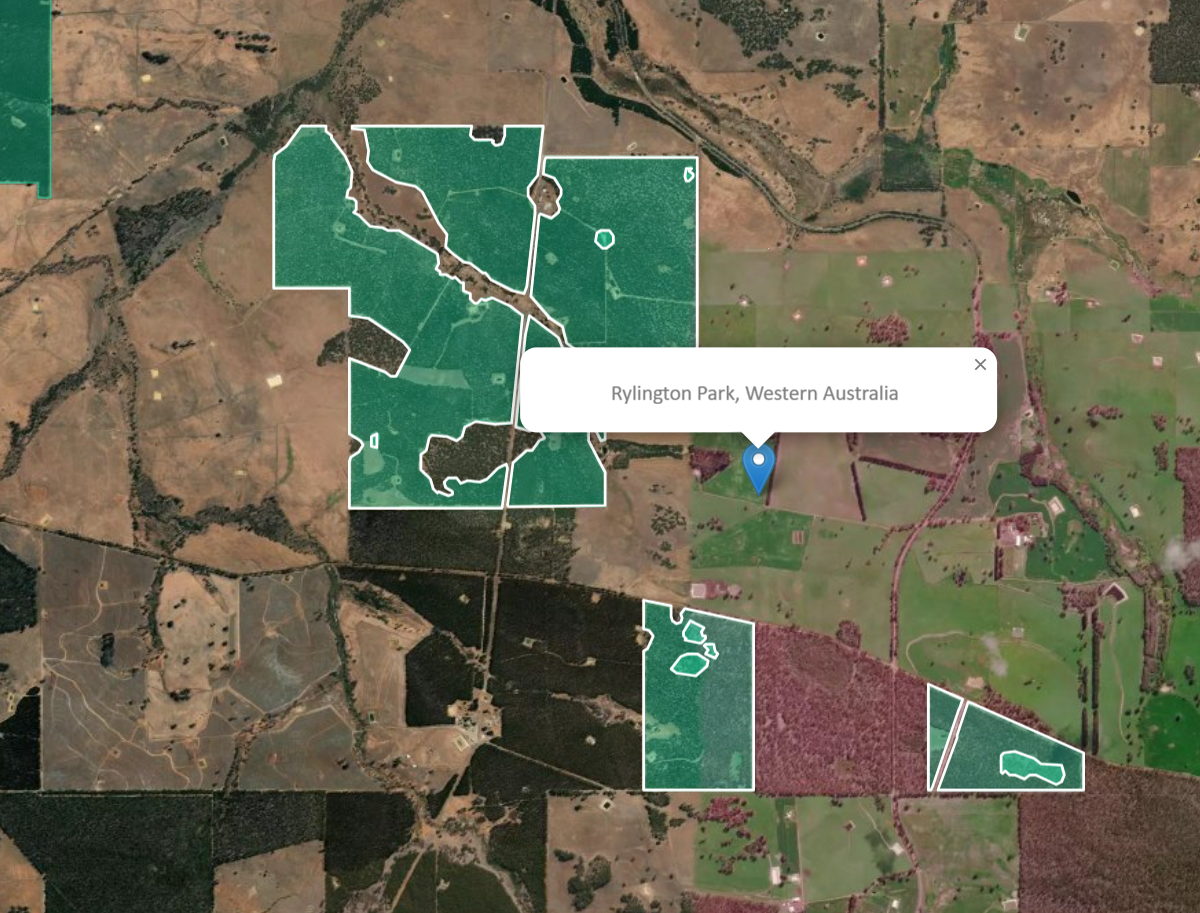
Located in the Boyup Brook area of Western Australia, this project focuses on converting an existing short-rotation plantation to a long-rotation forest, as well as establishing new plantation areas for commercial harvesting.
Projects such as this sequester carbon in two ways, first in the growing trees and soil, but also in the commercial wood products, which are made out of cut timber.
Mitsui & Co Wood Resources Oceania, the project proponent, is a major player in the Australian forestry supply chain, operating multiple tree farms, and generating revenue by exporting hardwood and softwood woodchips to Asian markets.
The project name probably pays homage to prominent local family, the Farleighs. In 1985, Eric Farleigh donated the 650-hectare Rylington Park, for ongoing agricultural research and community benefit.
Wykeham Carbon Project
ERF208785: View on Project Explorer
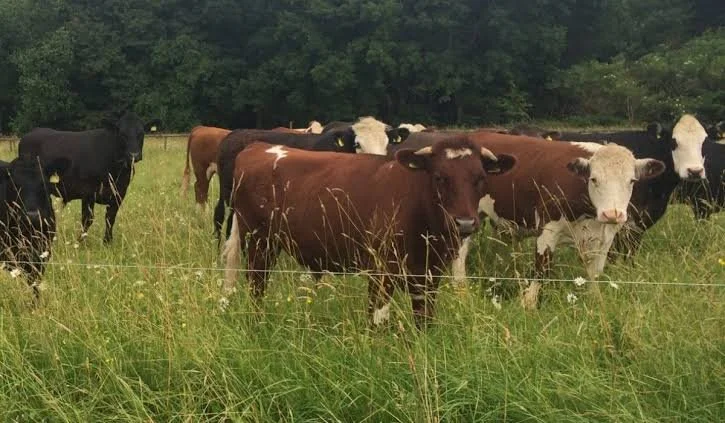
This soil carbon project in the Southern Grampians region of Victoria, is located on the scenic Wykeham agricultural property, which covers just over 1000 hectares.
Wykeham was bought by Michael and Anna Coughlan, prominent local livestock producers, in 2022. They are founding members of a farming group committed to regenerative and chemical-free agriculture, as well as holistic grazing practices.
The Coughlans, as trustees for the Tarabah Land Trust, are the project proponents, with CarbonLink acting as agents. The project aims to increase vegetation and soil health, by altering the stocking rate, duration, and intensity of grazing.
The surrounding Dunkeld area is well known for prime lamb breeding, cattle grazing, and broadacre mixed farming.
Credits issued
A total of 1.937 million credits were issued to 90 different projects in July, across a whole range of method types and geographical locations. While one project - Lucas Heights 2 Landfill Gas Project - accounted for about a quarter of total issuance, the smallest individual award, for 320 ACCUs, went to Ansfield Reforestation Project. For 11 projects, it was their first credits, while the remaining 79 projects had received at least one previous award.
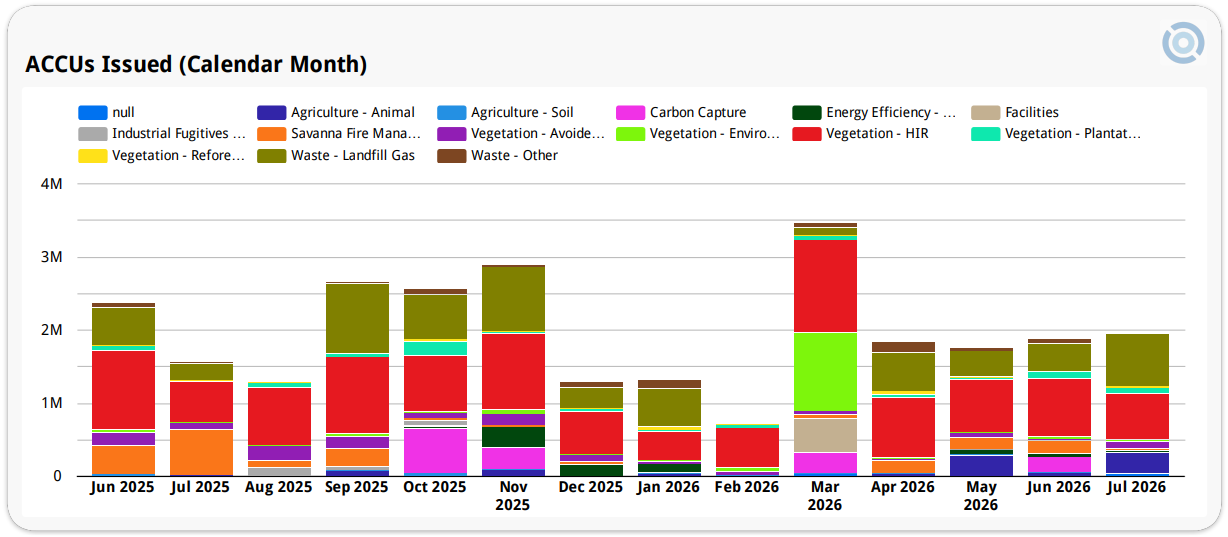
Vegetation methods (including plantation forestry, human-induced regeneration and environmental planting) accounted for the highest total issuance (840,458) and the largest number of projects (56).
Second overall on both metrics was waste (principally landfill gas), with 727,442 ACCUs across 25 projects. Together, vegetation and waste accounted for 1,567,900 ACCUs, representing over 80.9% of the total credits issued in July.
Although only one agriculture project - AACo's Beef Cattle Herd Management Carbon Project - earned credits, it was a whopping 289,569 ACCUs.
Savanna fire management (51,262 ACCUs, across five projects), and energy efficiency (28,294 ACCUS, across three projects), were the other two methods to gain credits in July.
There was a large geographical spread to the projects, with New South Wales and Queensland the top two, in terms of both total credits and number of projects:
New South Wales: 837,073 ACCUs/29 projects;
Queensland: 329,614/27;
Northern Territory/Queensland: 289,569/1;
Western Australia: 256,851/12;
Victoria: 98,432/10;
Northern Territory: 77,928/3;
Tasmania: 29,597/3;
South Australia: 10,652/4;
Australian Capital Territory: 7,309/1.
The proponents with the most projects were LMS Energy with 21 waste schemes, earning a total of 181,668 credits, and TerraCarbon, with 17 vegetation projects, securing a total of 181,848 ACCUs. The largest two individual awards went to proponents with one project apiece:
Bioenergy specialist EDL(LFG), which was credited 471,417 ACCUs, for a landfill gas project in New South Wales (see below);
And AACo (Australian Agricultural Company), which took 289,569 credits for a beef cattle herd project in Northern Territory and Queensland.
To view ACCU statistics and trends head to Analytics Dashboard and create a free account to access additional pages.
Some of the credited projects
Lucas Heights 2 Landfill Gas Project
ERF100105: View on Project Explorer
Lucas Heights is the most successful carbon farming project in Australia, in terms of total credit issuance. Its latest award of 471,417 ACCUs, took its overall credits to 4,143,238. The facility is located about 30km south west of central Sydney.
First registered in 2012, and run by bionergy specialist EDL(LFG), the project has now been awarded credits in 13 financial years. In April 2025, it was contracted by the Commonwealth to abate 1,405,774 ACCUs, which has been successfully fulfilled.
Electricity generation from landfill gas projects involve the active capture of biogas, primarily methane, produced by the decomposition of organic matter in landfill sites. The captured gas is then combusted to produce electricity. Lucas Heights 2 has a generating capacity of 16.7 MW.
This project has transitioned through two previous methods, most recently in February 2022, to the Electricity generation from landfill gas method 2021, which has since been revoked. EDL(LFG) runs an adjacent project, Lucas Heights 2B Landfill Gas Project, which has a total credit issuance so far of 1,238,854 ACCUs.
Heffernan Forest Regeneration
ERF103181: View on Project Explorer
This is a human-induced regeneration (HIR) project located in the outback region of New South Wales. Located about 35km south east of Wanaaring it covers approximately 142,000 hectares.
HIR projects establish permanent even-aged native forests through assisted regeneration. In this case, regeneration from in-situ seed sources is achieved by managing the timing and extent of grazing, and humanely managing feral animals.
This massive project was set up by Garry Michael Heffernan, who is known locally for operating Ularara Station near Wanaaring. The project agent is Carbon Farmers of Australia. July’s award of 76,653 credits, took its total issuance to 1,935,119 ACCUs.
This project was contracted to sell 1,704,718 ACCUs to the Commonwealth in April 2016, of which 1,032,165 has been fulfilled.
The remote Bourke and Wanaaring region is known for large-scale pastoral operations, primarily grazing cattle, sheep, and goats. The area is classified as semi-arid with low annual rainfall.
Revoked projects
In a rare occurrence, all 11 projects which were voluntarily revoked in July were registered under the same method, soil organic carbon. SOC specialists AgriProve was the proponent on 10 of these projects. All 11 were revoked under section 30 of the CFI (Carbon Farming Initiative) Rule 2015, which applies when projects have not earned any ACCUs.
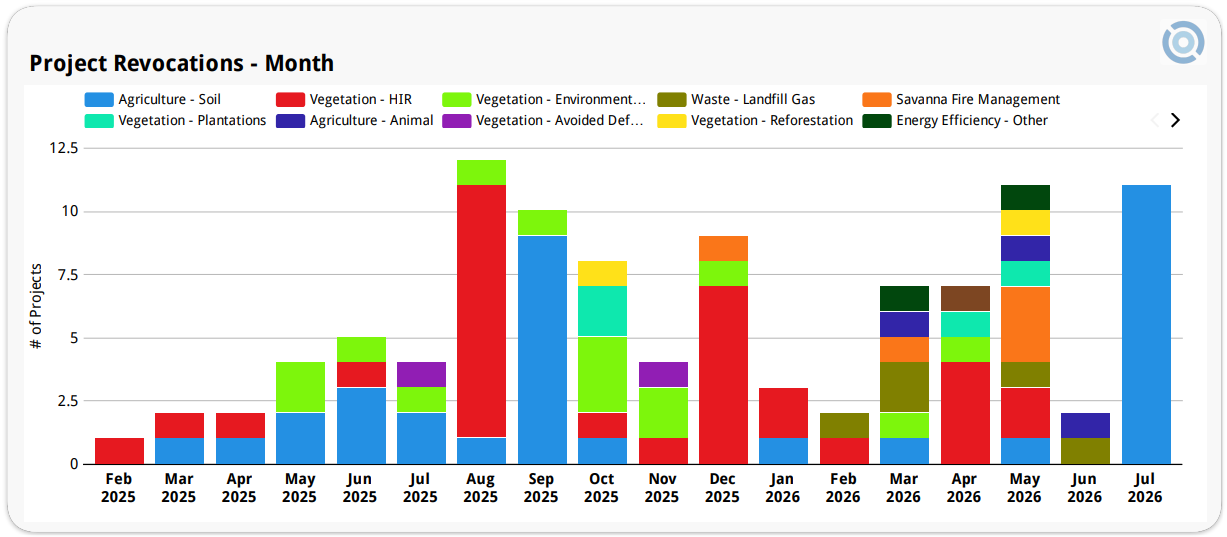
While this is the joint highest monthly total of revocations since August 2025, the process is not necessarily a negative one. Projects can be voluntarily revoked for a number of reasons, including transitioning to a different method, or changing business priorities. See the latest projects from the project register updates here (best in List View).
To view ACCU statistics and trends head to Analytics Dashboard and create a free account to access additional pages.
Join our community to get the latest carbon market intelligence delivered monthly
See the latest projects for yourself in Project Explorer here (for best experience, view on desktop and toggle to List View).
Want to know more?
Check our time lapse video from 2012 to today showing the growth of Australia's ACCU scheme, or in case you missed it, last months register update: June saw 25 new ACCU projects registered
References
Clean Energy Regulator (CER):
Carbon Eyes ACCU project register and project level analytics
Carbon Eyes market commentary on ACCU project activity and issuance trends
Carbon Eyes | Carbon Market Intelligence
The independent view of Australia's carbon market.
1. Discover projects
Find and shortlist ACCU projects using structured CER data, market information and enriched project and land data. Get notified of project changes.
2. Understand the risks
Assess individual projects using detailed data, risk metrics and independent rating breakdowns, to understand project quality, characteristics and potential risks.
3. Go deeper
Get a detailed independent assessment of an individual project for high value procurement, investment, lending and offtake decisions.