
Carbon market insights: close to 2 million credits shared amongst 90 projects
Carbon Eyes In the Loop - here’s what you missed
A round-up of our best posts about the carbon market, filtered and in one place. Reach out to the team for more detailed market analysis and further insights.

August saw a number of developments across the Australian carbon market, most notably the publication of the final Bill to bring about major reforms to the ACCU scheme. We go through the proposed changes, and how they differ from the earlier draft Bill. This edition also looks at the latest monthly ACCU register update from Clean Energy Regulator, with soil carbon dominating both new registrations and voluntary revocations in July. In terms of issuance, a total of just under 1.94 million credits were shared amongst 90 projects. Moving on to the INFM method - linked to the creation of the Great Koala National Park - we ask why it is proving so controversial. And we look into the continued issuance of credits to the revoked avoided deforestation method. Also in this edition, we address the supposed risk posed to productive farmland by carbon farming. To round things off, are the buyers of a large property in Victoria’s High Country going to pivot towards environmental planting? As always, our focus remains on the project data and market signals shaping Australia's carbon market. For more comprehensive market insights and analysis, please get in touch at info@carboneyes.io. See all the latest projects here (best in List View).
Is productive agricultural land being lost to carbon projects? [28/08/2026]
The headline numbers suggest this may be the case, with approximately 19.7% of Australian farmland registered as an ACCU project area.
However, looking past the headline numbers, a different story emerges. Looking a project methods, savanna fire (43%), human-induced regeneration (51%), soil organic carbon (1.3%) and avoided deforestation (1.3%), make up 97% of the area under ACCU projects. Some of these methods enhance existing agricultural land, whilst others, such as HIR, have a temporary impact.

Carbon Estimation Areas are more useful than project areas for monitoring land use change. CEAs are published for most projects where carbon credits have been issued. To view ACCU projects, project areas, and CEAs see https://app.carboneyes.io/project-explorer.
Environmental planting (EP) projects have a registered area of 484,085 hectares, which represents 0.65% of ACCU project area and below 0.13% of Australian farmland. When one considers reported CEAs - the actual area being planted - combined with estimated unreported CEAs, this drops to 0.07%. Some EP projects are being run with continued grazing.
The plantation forestry footprint is even smaller with 216,000 hectares under ACCU projects (0.06% of farmland). This represents under 0.01% of Australian farmland once CEAs and the fact that only two of the four plantation project types/schedules impact land usage. Recent data indicates that plantation areas are about 260,000 hectares below their 2014 levels.
This post on LinkedIn drew a number of responses on the issue, with most suggesting that the supposed threat to farming land posed by carbon projects has been overblown.
Andrew Heald, Chair and Co-founder of Inovaland, says there needs to agreement on what does and doesn’t count as an “acceptable” use of agricultural land. He also noted double standards when it comes to carbon farming compared to other agricultural practices:
“In the UK growing maize for biodigesters or wheat for bioethanol, or growing hemp for fibre, or miscanthus rarely raises an eyebrow. In England alone last year the government paid farmers to grow over 200,000 hectares of wild bird seed and there was barely a murmur about food security. However, use a small proportion of the same land to grow timber and suddenly it’s a loss of ‘productive’ land and there are headlines about food imports.”
Rod Keenan, GAICD, Honorary Professorial Fellow, University of Melbourne, Board Member, says the issue points to a problem with current ACCU methods:
“Being tied to specific activities (eg plantation forestry or environmental plantings) they don’t allow for an integrated approach to incorporating trees in farming systems for multiple objectives. Most Australian farms would be more profitable and sustainable with 10-20% of their ‘productive’ land under trees”.
Kelly Campbell, Spatial Intelligence for Carbon Markets and Nature-based Solutions, Remote Sensing, noted that the proposed IFLM (Integrated farm and land management) method, was intended to address Keenan’s point:
"However, I’m not quite sure the draft in its current form encompasses quite as many broad methods as was originally intended.”
She added that the registered project area is not indicative of the carbon estimation area for many vegetation methods, and this means:
“The eligible area footprint is typically much smaller and the area ‘lost’ (or enhanced) as you say to carbon projects is much smaller.”
Overall, the supposed risk of carbon projects to productive farmland has been overblown. Indeed, in practice, carbon projects can actually enhance agricultural yields, by for example promoting soil fertility, increasing water retention, reducing the risk of bush fires, and giving shade to heat-stressed livestock.
31,000 hectare Victorian property likely to pivot to environmental plantings [03/08/2026]
Carbon fund Silva Capitalis the reported buyer of Cobungra Station near Omeo, in Victoria’s High Country. The area is known for extensive cattle and sheep grazing operations across its mountain valleys, alongside some forestry operations.
The property comprises roughly 6,500 hectares of freehold land, and 24,500 hectares of alpine leases, with pockets of the former being eligible for environment planting projects. The area enjoys very high planting yields and already has seven EP projects, four of them by Canopy Nature.
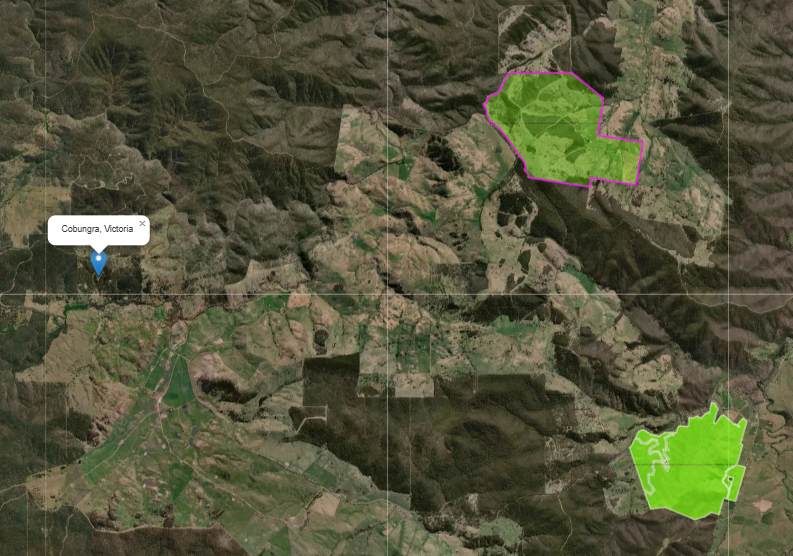
To view the closest EP project to Cobungra Station - Solara Environmental Planting - and other projects in the area, see Carbon Eyes Project Explorer.
To see the real estate listing.
The seller of Cobungra Station is ASX-listed Rural Funds Management Limited (RFF), which bought Cobungra in 2019 for approximately 35 to 37 million dollars. It has been leasing it to Wagyu beef producer Stone Axe Pastoral Company.
Silva Capital is a joint venture between Roc Partners and C6 Investment Management. It has three active ACCU projects, including two EPs - Cooplacurripa Environmental Planting Project Phase 1 and Phase 2) - at Cooplacurripa Station, in the mid North Coast hinterland of New South Wales.
EP projects establish permanent plantings of native tree and shrub species, typically at a stocking density of at least 200 stems per hectare, in order to achieve permanent forest cover.
The INFM method: why is it causing such division? [13/08/2026]
What is it?
The Improved native forest management method (INFM), is a new ACCU method which is proving to be very controversial. It allows state governments to earn carbon credits for ceasing logging in defined areas of multiple-use public native forests, that would otherwise be used for commercial forestry. It is important to note that INFM does does not ban forestry in public native forests.
How did it become political?
Labor made a promise before the New South Wales state elections in March 2023 to create the Great Koala National Park. The proposed park will protect 176,000 hectares of state forest, and connect it with existing national parks and reserves in the north of the state. The INFM method was created as a pathway to facilitate this. But it could also be used for other public native forests in the future.
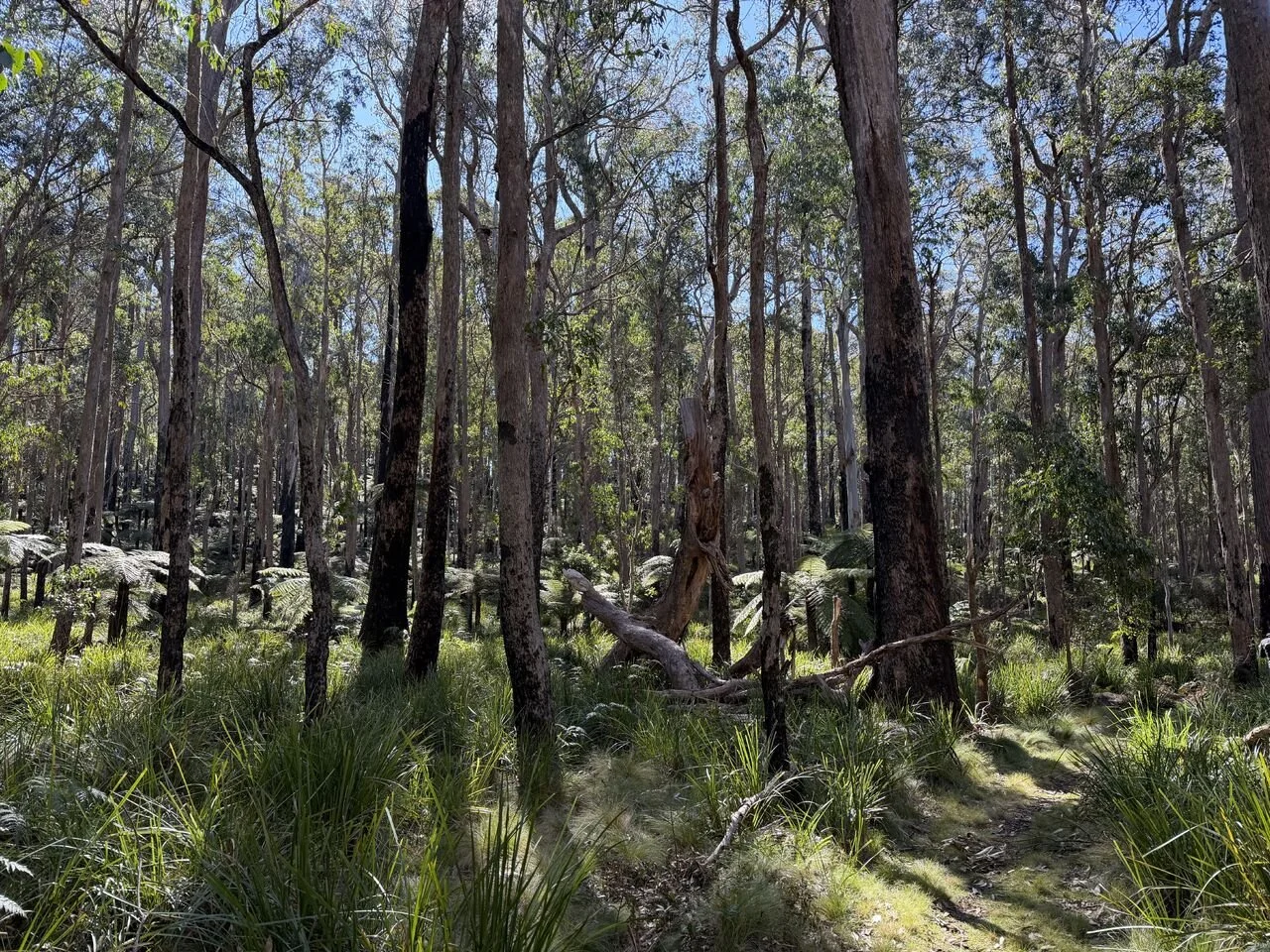
Photo: Mummel Gulf National Park, NSW
Who created the method?
The NSW Department of Climate Change, Energy, the Environment and Water, partnered with the Australian National University (ANU), to develop the method. Funding to develop INFM came from the NSW Environmental Trust as well as the National Parks and Wildlife Service.
What was the development process?
The Federal Government prioritised development of the method in October 2024, following an expression of interest from the NSW Government in June 2024. The draft method underwent technical development, with stakeholder engagement and public consultation. Following this, INFM was submitted for assessment by the Emissions Reduction Assurance Committee (ERAC). The committee found the method met statutory Offsets Integrity Standards (OIS). On June 25 2026, the method was approved by the Australian Government Assistant Minister for Energy and Climate Change.
When happens next?
INFM should come into force on October 1, with a planned expiry date of September 30, 2036. However, it still faces a disallowance motion in the Senate on September 15, following a four week delay from a planned debate on August 18.
What are supporters saying?
Support is mostly centred around the broader outcomes of adopting the method, rather than the technical design of the method itself. Direct and indirect outcomes include the creation of the national park, stopping native forest logging, and providing an alternative economic pathway to state forest logging.
Some supporters have argued that other methods, for example human-induced regeneration (HIR) are weaker in comparison, and/or that the volume of ACCUs is not significant enough to warrant integrity concerns.
The NSW Government maintains that strict accounting controls are in place, which will consider:
Changes in carbon stored in forests and forest debris;
Carbon stored in harvested wood products;
Emissions from harvesting activities;
Potential “leakage” where harvesting may increase elsewhere;
Impacts of natural disturbances such as bushfire.
David Lindenmayer, ANU Professor of Ecology and Conservation Biology, writing in Pearls and Irritations, acknowledges concerns about carbon offsets, which he believes delay genuine decarbonisation. But he argues that INFM is different and should be supported:
“A lot of effort has gone into ensuring the INFM method has high integrity and is free of the problems that have plagued other types of offsets. There is no doubt the INFM method will result in a significant boost in protection for native forests, that is protecting not only large amounts of carbon but also protecting large amounts of biodiversity. And it will achieve this without undermining the efforts to decarbonise the economy.”
What are detractors saying?
The loudest criticism has come the forestry industry, which sees a direct economic threat to its bottom line. It argues that INFM will lead to job losses, without achieving the claimed reductions in greenhouse gas emissions, because wood products and their alternatives will have to come from elsewhere.
There has also been been criticism from some environmental and conservation groups, as well as ACCU scheme stakeholders and commentators. The main concern is that the method could create integrity questions around the Australian carbon credit landscape.
Specific concerns include:
Additionality, in other words, whether some of the logging would have ended anyway;
The 40% cap on the indirect leakage deduction, raising concerns about where replacement timber will come from;
Assumptions used in FullCAM (for example harvesting);
The 15 year accounting approach.
It should be noted that ERAC considered additionality, leakage and modelling transparency, and concluded that the revised method met all six Offset Integrity Standards.
Some environmentalists are apposed to the broader concept of carbon offsetting, arguing that in the case of INFM, protecting a state forest or national park should not earn ACCUs, because it will reduce the incentive for polluters to cut emissions at source.
In a paper by University College London Associate Professor Fergus Green, published in August, he argues:
“While Commonwealth government policy is based on the idea that the harm from fossil fuel emissions can be ‘offset’ via the purchase of carbon credits, climate science does not support this approach. The harm to the climate system caused by fossil fuels cannot be undone by the Koala Park because it does not permanently remove carbon from the atmosphere and would likely have been established anyway.”
Controversy over the INFM method comes at a critical time for the future of the ACCU scheme. The Safeguard Mechanism, which underpins the carbon credit market in Australia, by assigning emissions reduction targets for major polluters, is currently undergoing an official review, which is due to release policy positions and any draft rule amendments in early 2027.
Further reading
David Lindenmayer (ANU Professor of Ecology and Conservation Biology), Why I support a carbon method for limiting the emissions from native forest logging (Pearls and Irritations, August 9, 2026) and LinkedIn Post.
Michelle Freeman (forest scientist) Native forest carbon credits aren’t counting real climate benefits (Australian Financial Review, August 12, 2026).
Article by staff writers in the point, on August 12, 2026: Controversial carbon credit scheme faces further integrity concerns
Soil carbon dominates ACCU registrations in July [19/08/2026]
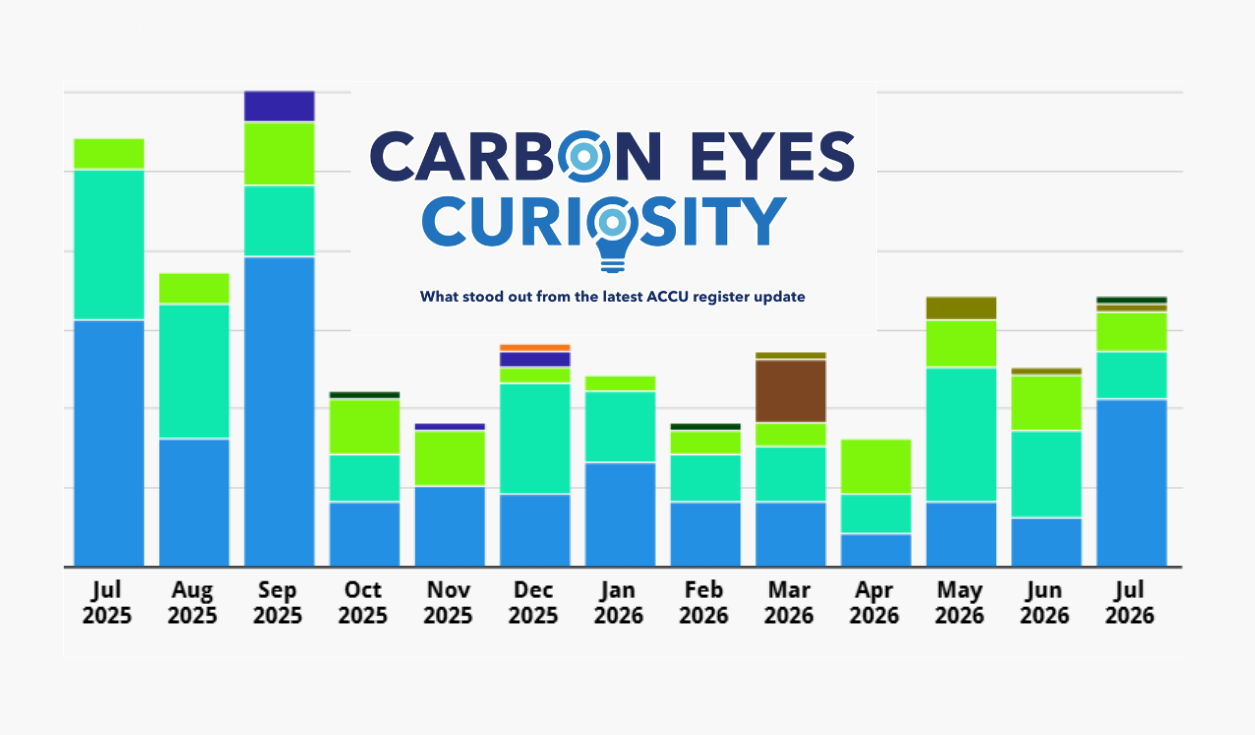
Of the 34 new projects registered in July, Soil organic carbon (SOC) accounted for 21 of them. The latest monthly update by the Clean Energy Regulator also saw 90 projects earning a total just shy of 1.94 million ACCUs. Meanwhile, 11 projects - all of them SOC - were voluntarily revoked. For more information about the update, see the latest edition of Carbon Eyes Curiosity.
New registrations
July's tally of new registrations was the joint highest monthly total since September 2025. Of the 21 SOC projects, 12 were multiple projects on the same land title: nine at Moya Farm in South Australia, and three at Stonehaven in Queensland.
A periodic review by the Emissions Reduction Assurance Committee (ERAC) recommended several changes to the 2021 SOC (Estimation of soil organic carbon sequestration using measurement and models) method. These include an end to multiple projects on single land titles.
There are now 956 active soil projects, covering more than one million hectares of land. Despite its increasing prominence, only 53 SOC projects have earned ACCUs, with no fresh credits in July.
After soil, the next most popular method was plantation forestry, with six new projects, followed by environmental planting (5), energy efficiency (1) and landfill gas (1). Only two of the 34 projects opted for 100-year permanence.
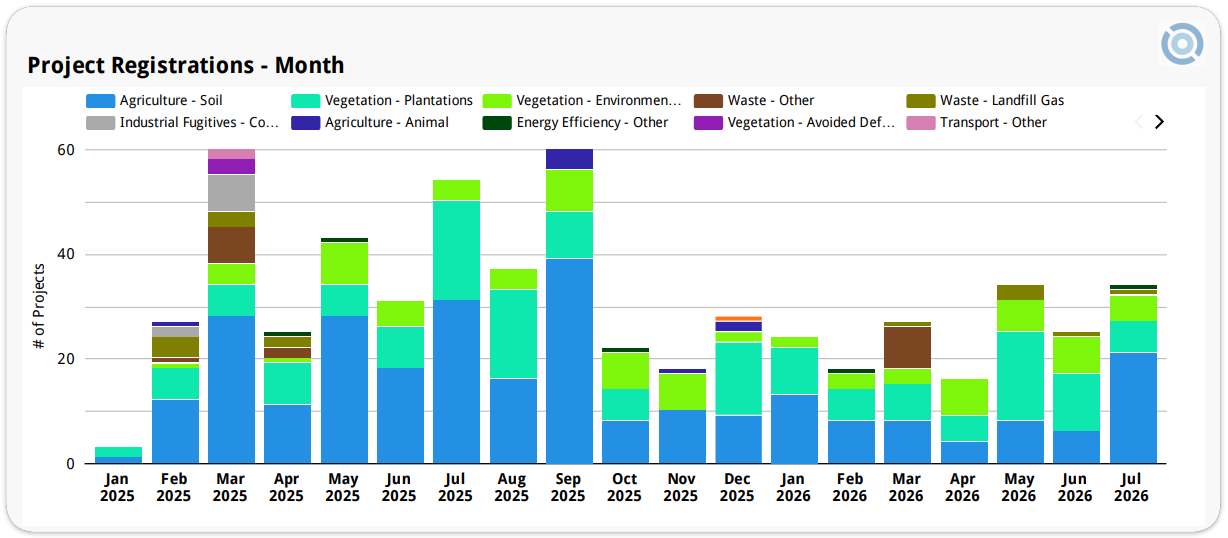
South Australia had the most new projects (11), followed by New South Wales (7), Queensland (7), Victoria (5), Western Australia (3), and Tasmania (2). One project is sited in two states (New South Wales and Victoria).
In terms of proponents, AgriProve led with 13 new projects, followed by CarbonLink (3), APAC Natural Capital (3), and Precision Pastures (1).
See all the latest projects here (best in List View). To view ACCU statistics and trends head to Analytics Dashboard and create a free account to access additional pages.
Credits issued
A total of 1.937 million credits were issued to 90 different projects in July, across a whole range of method types and geographical locations. While one project - Lucas Heights 2 Landfill Gas Project - accounted for about a quarter of total issuance, the smallest individual award, for 320 ACCUs, went to Ansfield Reforestation Project. For 11 projects, it was their first credits, while the remaining 79 projects had received at least one previous award.
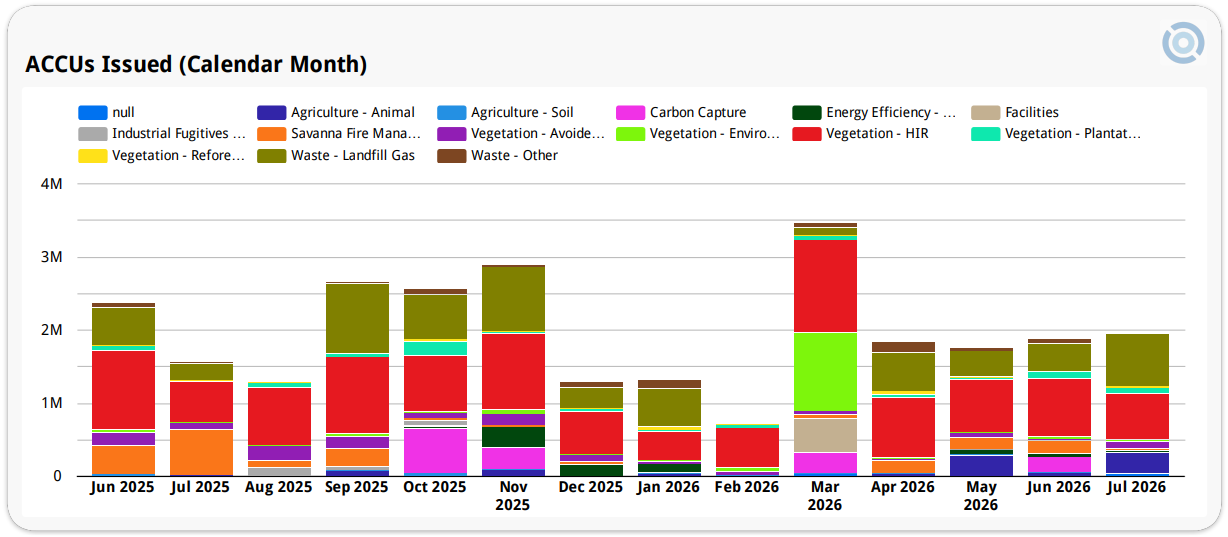
Vegetation methods (including plantation forestry, human-induced regeneration and environmental planting) accounted for the highest total issuance (840,458) and the largest number of projects (56).
Second overall on both metrics was waste (principally landfill gas), with 727,442 ACCUs across 25 projects. Together, vegetation and waste accounted for 1,567,900 ACCUs, representing more than 80% of the total credits issued in July.
Although only one agriculture project - AACo's Beef Cattle Herd Management Carbon Project- earned credits, it was a whopping 289,569 ACCUs.
Savanna fire management (51,262 ACCUs, across five projects), and energy efficiency (28,294 ACCUS, across three projects), were the other two methods to gain credits in July.
There was a large geographical spread to the projects, with New South Wales and Queensland the top two, in terms of both total credits and number of projects:
New South Wales: 837,073 ACCUs/29 projects;
Queensland: 329,614/27;
Northern Territory/Queensland: 289,569/1;
Western Australia: 256,851/12;
Victoria: 98,432/10;
Northern Territory: 77,928/3;
Tasmania: 29,597/3;
South Australia: 10,652/4;
Australian Capital Territory: 7,309/1.
The proponents with the most projects were LMS Energy with 21 waste schemes, earning a total of 181,668 credits, and TerraCarbon, with 17 vegetation projects, securing a total of 181,848 ACCUs. The largest two individual awards went to proponents with one project apiece:
Bioenergy specialist EDL(LFG), which was credited 471,417 ACCUs, for a waste facility in New South Wales, Lucas Heights 2 Landfill Gas Project;
And AACo (Australian Agricultural Company), which took 289,569 credits for a beef cattle herd project in Northern Territory and Queensland.
To view ACCU statistics and trends head to Analytics Dashboard and create a free account to access additional pages.
Revoked projects
In a rare occurrence, all 11 projects which were voluntarily revoked in July were registered under the same method, soil organic carbon. SOC specialists AgriProve was the proponent on 10 of these projects. All 11 were revoked under section 30 of the CFI (Carbon Farming Initiative) Rule 2015, which applies when projects have not earned any ACCUs.
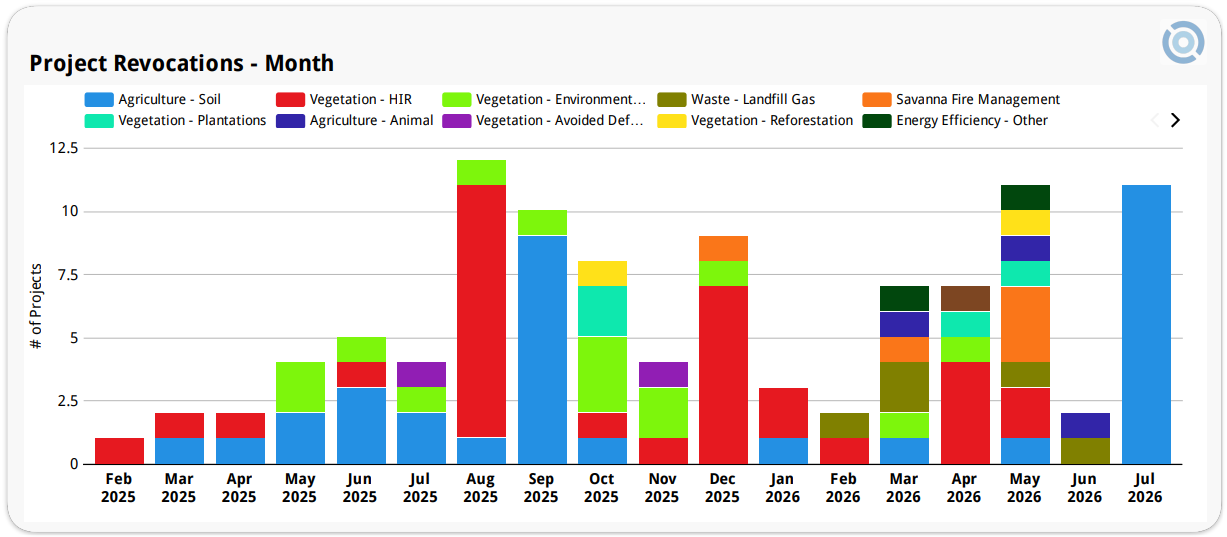
While this is the joint highest monthly total of revocations since August 2025, the process is not necessarily a negative one. Projects can be voluntarily revoked for a number of reasons, including transitioning to a different method, or changing business priorities.
See the latest projects from the project register updates here (best in List View). To view ACCU statistics and trends head to Analytics Dashboard and create a free account to access additional pages.
ACCU scheme reforms: final Bill for Parliament published [20/08/2026]
The Carbon Credits and Other Legislation Amendment (Integrity and Transparency) Bill 2026, includes major changes to the way the Australian Carbon Credit Unit scheme is operated. These range from improved First Nations consent, to integrity risk management.

After the draft Bill was released in April, another round of consultation was invited. In all, there were 73 published submissions, many of which pulled in different directions. Following the consultation process, the Bill saw some significant amendments.
Rebranding of “integrity risk” to prevent market panic
At present, projects can still claim credits, even after a method has been revoked, following integrity concerns. The draft legislation proposed an end to this practice. Following pushback from carbon project developers and industry advocates (including Climate Friendly, the Carbon Market Institute (CMI), and Nateva: Leading with Nature), a higher bar has been set for this to happen. The Minister would be able to make a Method Transition Declaration - ending credits to a revoked method - only if all affected projects would be able to transition to at least one alternative method.
Strengthening First Nations consent rights
The draft bill expanded the prior consent requirement to include registered native title holders. But this did not go far enough for First Nations representatives. The need for prior consent has now been extended to a wider group of native title claimants. An ACCU project on native title, or claimed native title land, would not be able to proceed without this consent.
Research and development exceptions to the “newness” rule
Climate Friendly and Australian Pork Limited successfully argued that R&D trials could be impacted by the requirement for activities to count as new when a project is registered. The final Bill introduces a targeted exception to the newness requirements for genuine research and development. This change is intended to support innovation and testing of emerging abatement technologies.
There were some areas where the submissions do not appear to have changed the final Bill. For example, environmental groups argued that if a method fails the Offsets Integrity Standards (OIS), it should be declared an integrity risk immediately. The final Bill maintained the draft position that a suitable alternative method must exist first.
The overall aims of the proposed reforms are to:
Improve prior consent processes for ACCU scheme projects on native title and claimed native title land.
Strengthen the independent committee and governance around ACCU methodology determinations. As part of this, the Emissions Reduction Assurance Committee (ERAC) is being replaced by the Carbon Abatement Integrity Committee (CAIC), with stronger conflict of interest guardrails.
Moving responsibility and increasing flexibility for government purchasing of carbon credits, while ensuring a clear separation of responsibilities between agencies carrying out purchasing processes, and regulators of the ACCU scheme.
Improving integrity and compliance frameworks in the ACCU Scheme, including expansion of the fit and proper person test, and strengthening safeguards to ensure projects are not over-credited.
Encouraging participation in ACCU Scheme projects and innovation in new methods. This includes changes which would allow a single method to earn credits for both carbon sequestration and emissions avoidance activities within the same project.
Enhancing and streamlining administration of the ACCU Scheme, while creating more flexibility for participants. One notable change would be to allow projects to transition from one method to another, without requiring revocation and re-registration, so long as appropriate rules are met.
Although most attention has focused on the way the proposed legislation would reform the Carbon Credits (Carbon Farming Initiative) Act 2015, it also includes amendments to two other laws: the National Greenhouse and Energy Reporting Act 2007, and the New Vehicle Efficiency Standard Act 2024.
Submissions can be seen at Credits and Other Legislation Amendment (Integrity and Transparency) Bill Consultation.
The final Bill: Carbon Credits and Other Legislation Amendment (Integrity and Transparency) Bill 2026.
Avoided deforestation: why are credits still flowing? [24/08/2026]
This method has been responsible for 16.7% of credits issued since the start of the ACCU scheme. AD projects claim credits on the basis of protecting forested land which would otherwise have been cleared. The Avoided deforestation 1.1 method 2015, was dogged by doubts about whether the affected land was really in danger of being cleared.
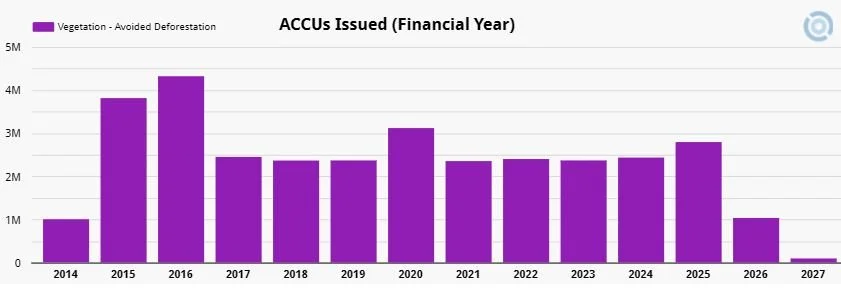
Despite being revoked in February 2023, AD projects are still earning credits, although this has slowed over the last couple of years, as crediting periods expire.
There are two main reasons that ACCUs are still being issued:
There are still 13 active AD projects within their crediting periods, with a range of end dates up to 2036.
Developers have the option to survey the project areas for the final offset report. This end-of-crediting survey can generate additional forest growth and sequestration credits.
Most of the projects still within their crediting periods are by GreenCollar's TerraCarbon. The project with the largest carbon estimation area that is still within its crediting period, is the Nemeena Avoided Deforestation Project.
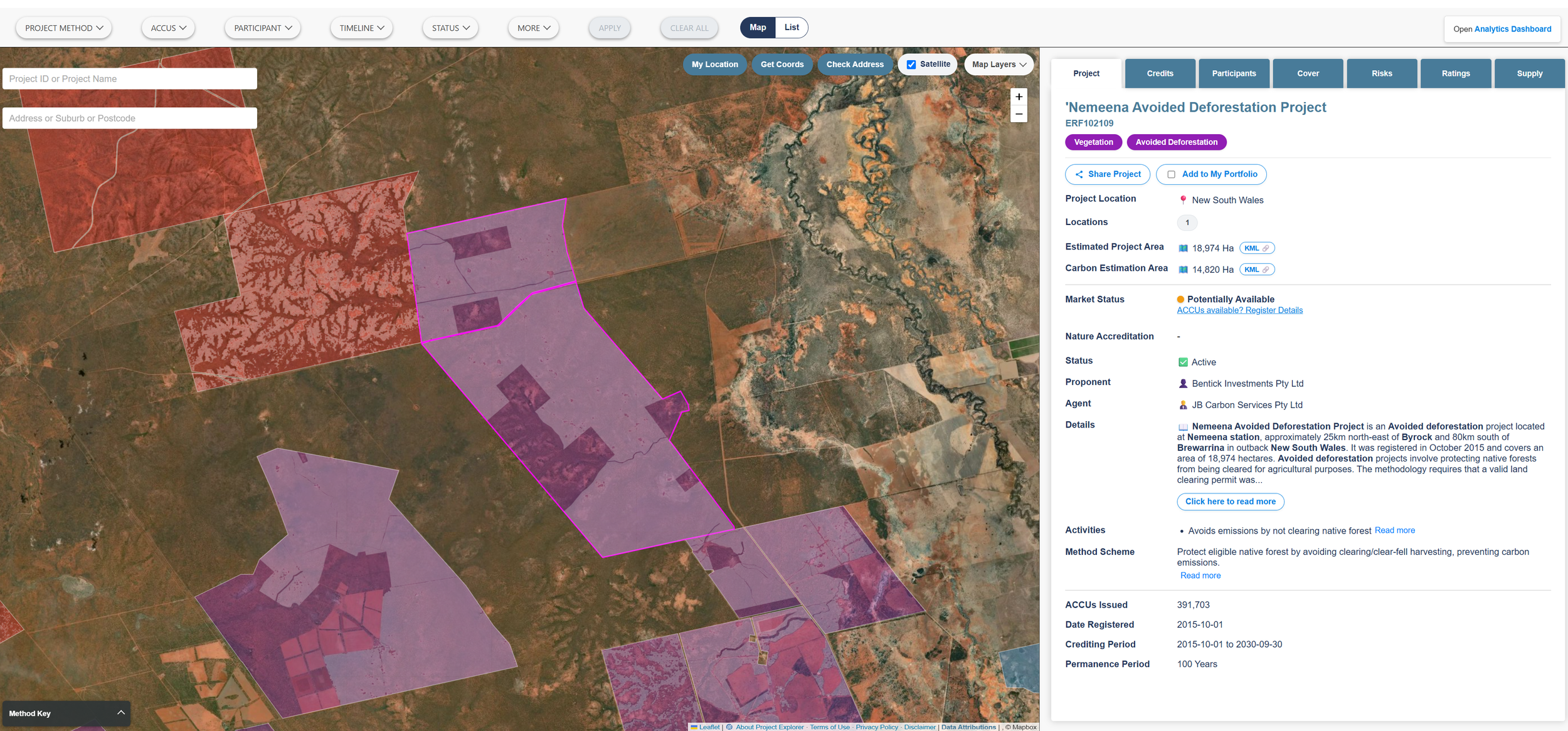
Under the Carbon Credits (Carbon Farming Initiative) Act 2015, projects can still claim credits even if a scheme has been revoked over integrity concerns. Proposed reforms to the ACCU scheme (see above), would give the Government the power to declare a Method Transition Declaration, ending credits for a revoked (or expired) method. But for that to happen with avoided deforestation, all 13 of the remaining projects eligible for credits, would have to be able to transition to at least one alternative method.
As always, we will continue tracking the underlying project data, register movements and policy developments shaping the Australian carbon market.
For more comprehensive market insights and analysis, please get in touch at info@carboneyes.io.
Join our community to get the latest carbon market intelligence delivered monthly
Check out our blog article Who is paying for carbon projects in Australia, discussing fund–backed ACCU activity and what it means for investors.
References
Carbon Eyes ACCU project register and project level analytics
Carbon Eyes market commentary on ACCU project activity and issuance trends
CER (Clean Energy Regulator)
Want to know more?
Check out New environmental planting project to boost ACCU supply discussing what large-scale plantings tell us about supply.
Carbon Eyes | ACCU Market Intelligence
Strategic data and integrity signals for the Australian carbon market.
1. Carbon Data Platform
The Foundation of Market Transparency | Access the Platform
A comprehensive view of the ACCU landscape. Access structured CER data, project status and issuance trends. Use our core mapping and analytics to establish your market baseline.
2. Integrity & Market Intelligence
Independent Ratings & Supply Forecasts | Upgrade Your Intelligence
Mitigate risk with our paid intelligence layer. Accessed directly within the Platform, these add-ons provide independent ACCU project ratings and forward looking supply forecasts to guide procurement and investment.
3. Land & Asset Decisioning
Identify the Best Opportunities for Carbon Projects
Carbon Potential Report | View Carbon Potential Report (by address)
Instant, address-based viability assessments for lenders and investors.
Carbon Land Search | Identify & Assess High-Potential Assets
Our premium search engine for institutional funds. Identify and de-risk high-potential carbon assets before acquisition.