
Carbon credits that deliver: rebuilding trust in net zero
Rebuilding trust in Australia’s carbon market
Australia’s carbon neutral scheme has helped lift climate commitments, but questions remain around consistency, transparency and real outcomes.
The national programme to achieve carbon neutrality has helped many businesses show their commitment to tackling climate change. But questions have emerged about how consistent and effective it is. So what changes are needed to strengthen the scheme, and build momentum towards net zero?
What is net zero?
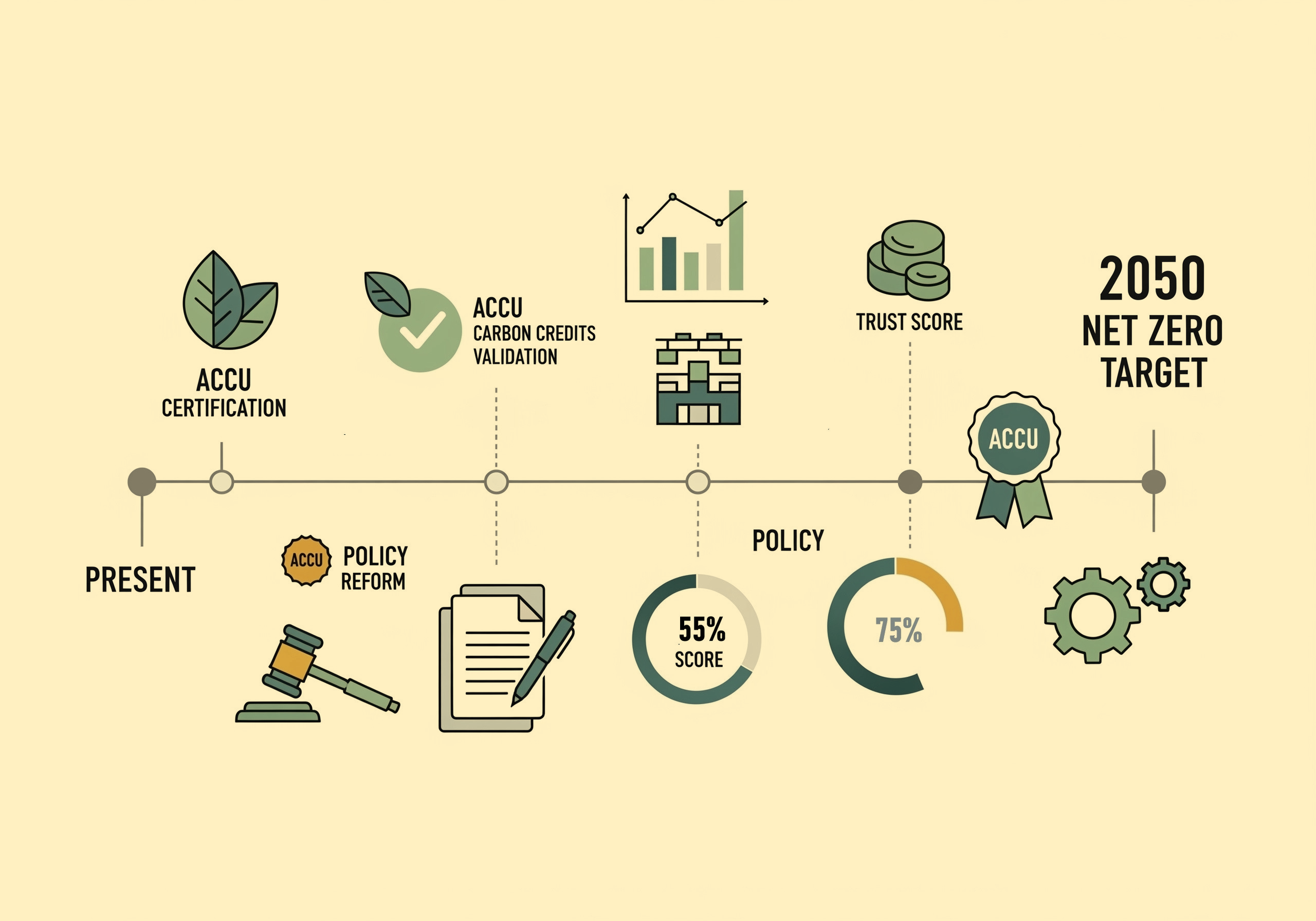
This means balancing the amount of greenhouse gases emitted, with the amount removed from the atmosphere, in order to limit climate change. In Australia’s case, federal and state governments, as well as businesses, NGOs and communities, are working towards achieving net zero by 2050. It’s a challenging goal, which would require not only cutting emissions, but also supporting projects that capture or avoid carbon and other greenhouse gases.
What is Climate Active?
The federal government’s carbon neutral certification programme is known as Climate Active. It sets standards for businesses and organisations to measure, reduce and offset their emissions. Companies that meet these requirements can use the Climate Active ‘green tick’ to show they are taking responsibility for their carbon footprint.
For years, businesses and government agencies have used the endorsement to bolster their green credentials. But during the past 18 months, more than a hundred bodies, both public and private, have walked away from the scheme. Why is this happening?
Offsetting without reducing
At the core is a simple question: are organisations genuinely cutting emissions, or just engaged in ‘green washing’? Are they buying carbon credits for reputational, rather than environmental reasons?
Professor Andrew Macintosh is Associate Dean (Research) at the Australian National University’s College of Law. He is one of Australia’s leading experts on carbon offsets, and a vocal critic of the country’s carbon credit system. Macintosh estimates that nine out of ten offsets used under Climate Active do not represent the claimed cuts in greenhouse gases:
We expect and we hope that 80% of the credits are legitimate and 20% are not quite there. An overwhelming body of evidence tells us it is more like 10% legitimate.
Macintosh estimates that offsets are being issued for forests across some 42 million hectares which don’t represent real change. He says credits are being earned for trees that would have been in the ground anyway, or which were never in any danger of being cut down.
Carbon Integrity Explorer is a free platform which analyses the three main methods dominating the Australian carbon offset market. It aims to provide transparency by highlighting which projects have strong integrity and which don’t. Macintosh says the platform’s findings are that:
The projects that lack integrity are crowding out the good projects.
Understanding carbon offset methods
The three methods that attract most scrutiny are:
Human induced regeneration (HIR) projects. These involve claiming credits for forests that regrow after clearing, but it’s hard to prove they would not have regrown anyway.
Landfill gas projects. These capture methane from waste sites, however the amount captured is highly uncertain.
Avoided deforestation projects. These focus on protecting forests that might have been cut down, but it’s often difficult to prove that there was a genuine risk.
All three methods aim to reduce greenhouse gas emissions that wouldn’t occur without these efforts, but each faces challenges around accurately measuring and proving their impact.
By contrast, environmental planting and soil organic carbon projects offer stronger scientific backing and clearer proof that carbon reductions are real and lasting. Their verification processes are more rigorous, often involving third-party audits and ongoing monitoring, which makes it easier to trust the outcomes and support genuine climate change action.

A scheme in need of repair not the scrapheap
This does not mean that all credits issued by the Clean Energy Regulator are flawed. Plenty of projects do provide real benefits and should be supported. But it’s important to verify each initiative, in order to ensure it’s making a positive impact.
John Connor, who is Chief Executive Officer of the Carbon Market Institute, agrees there are issues, but warns against throwing the baby out with the bathwater. He rejects the claim that credits are being issued for phantom forests:
These credits aren’t issued unless the Clean Energy Regulator satisfies themselves that forests are there. They rely on a variety of sources of data, [plus] an independent audit system.
If Australia is serious about hitting net zero targets, then frameworks or platforms like Climate Active are necessary. To be credible though, they require better rules, tighter oversight and increased transparency.
Landowners and project developers this is your moment
This conversation goes well beyond corporate boardrooms. For landholders investing in tree planting or improving soil health through better grazing and land management, trust in the carbon market is key. Right now there is a real opportunity to lead with integrity.
By focusing on projects that deliver tangible, measurable benefits like healthier soils, restored habitats and more resilient farms, landowners can set a new standard for carbon credits. This is about more than just meeting market demands, it is a chance to create lasting value for the land and communities, while helping to limit climate change.
With a spotlight on transparency and impacts, those who prioritise long-term outcomes will be best placed to succeed as the market moves forward.
The future is high integrity grounded in real outcomes
Markets are moving toward what is proven and credible. That means carbon projects which are backed by data, deliver clear benefits, and stand up to scrutiny. Done well, agricultural offset projects don’t just store carbon, they build long-term value for the land and the farmers managing it.
Time to rebuild trust
Carbon markets still have an important role to play. The challenge now is making sure projects are grounded in good science, support local communities and deliver real, measurable, outcomes. With the right focus, the Australian carbon offset market can become something people can believe in.
What to know more?
Listen to the full interviews with Professor Macintosh and John Connor on ABC Radio National
Carbon Integrity Explorer is an open access platform focusing on the main methods dominating Australia’s carbon offset scheme: human induced regeneration (HIR), landfill gas and avoided deforestation. All three methods aim to deliver carbon reductions which would not occur without intervention.
Read more about ACCU methods?
Check out ACCU methods unpacked: What’s driving real value? discussing performance across key ACCU methods. Generic price signals hide what’s really happening. Method-level data shows where confidence and demand are building.
Carbon Eyes | ACCU Market Intelligence
Strategic data and integrity signals for the Australian carbon market.
1. Carbon Data Platform
The Foundation of Market Transparency | Access the Platform
A comprehensive view of the ACCU landscape. Access structured CER data, project status and issuance trends. Use our core mapping and analytics to establish your market baseline.
2. Integrity & Market Intelligence
Independent Ratings & Supply Forecasts | Upgrade Your Intelligence
Mitigate risk with our paid intelligence layer. Accessed directly within the Platform, these add-ons provide independent ACCU project ratings and forward looking supply forecasts to guide procurement and investment.
3. Land & Asset Decisioning
Identify the Best Opportunities for Carbon Projects
Carbon Potential Report | View Carbon Potential Report (by address)
Instant, address-based viability assessments for lenders and investors.
Carbon Land Search | Identify & Assess High-Potential Assets
Our premium search engine for institutional funds. Identify and de-risk high-potential carbon assets before acquisition.