
Carbon credits, lobby groups and a so called ‘Trump tariff’
Why claims of a billion dollar carbon tax don’t add up
Repeated claims about carbon costs often come from lobby groups. The numbers tell a very different story about ACCUs and policy impacts.
Every few weeks an organisation will push out some media that attempts to undermine Australia’s climate and carbon objectives. These organisations are typically “think-tanks” or “institutes”, almost always funded by resources-aligned entities or individuals. Calling them lobby groups would not be much of a stretch.
The latest one to grab our attention is from the Institute of Public Affairs (IPA) and entitled THE SAFEGUARD MECHANISM: AUSTRALIA’S SELF-IMPOSED ‘TRUMP TARIFF’.
Not wanting to give them too much air-time, we still believe its worth investigating their claims that Australia’s flagship carbon programme, the Safeguard Mechanism:
“will impose a carbon tax cost of up to $1.7 billion per annum to 2030”
Playing their Trump Card - The Institute of Public Affairs
What is the Safeguard Mechanism?
This sets a yearly emissions limit for Australia’s biggest polluters and requires them to buy carbon credits if they exceed their limit. Alternatively, if they stay below their limit, they can bank or sell unused allowances.
Some quick fact-checking highlights a few gaps:
The authors state:
a significant cost of the safeguard mechanism will be incurred in the form of lost economic output due to reduced industrial activity (to meet emissions reduction targets)
This indicates a fundamental misunderstanding of how the Safeguard Mechanism works. The emission reductions are measured against the production-adjusted baseline¹. For example, if companies ramp up production, then they are “allowed” to emit more, as long as the emissions per unit of production are being reduced.
Along the same lines it is stated:
Some facilities will not rely exclusively on carbon credits to reduce their emissions to the baseline level. They will incur the cost in other ways, such as by reduced output or opting against expanding operations.
Again this reflects a misunderstanding of Safeguard Mechanism baselines. It also ignores the fact that most facilities have met baselines by reducing emissions rather than buying and surrendering carbon credits.
At a basic level, the article confuses abatement and sequestration. It lists land reforestation as an abatement activity, but this is incorrect, reforestation is a sequestration activity. Abatement avoids emissions and sequestration captures and stores them.
What is the crux of the article
The SM will impose a carbon tax cost of up to $1.7 billion per annum to 2030.
To assess this statement we need to look at some numbers from the most complete data available (2023-2024):
62 facilities beat their targets and received a total of 8.3 million Safeguard Mechanism Credits (SMCs), as their emissions were below their baseline². This mean emitters are beating their targets and getting rewarded with credits, which they can sell to emitters who aren’t meeting theirs. Or alternatively, they can keep them to offset in the future.
142 facilities missed their targets and incurred a total liability of 9.2 Mt CO2-e (that’s 9.2 million credits) because their emissions were above their baseline. To cover this, facilities surrendered (i.e. bought and used) 1.4 million SMCs and 7.1 million ACCUs.
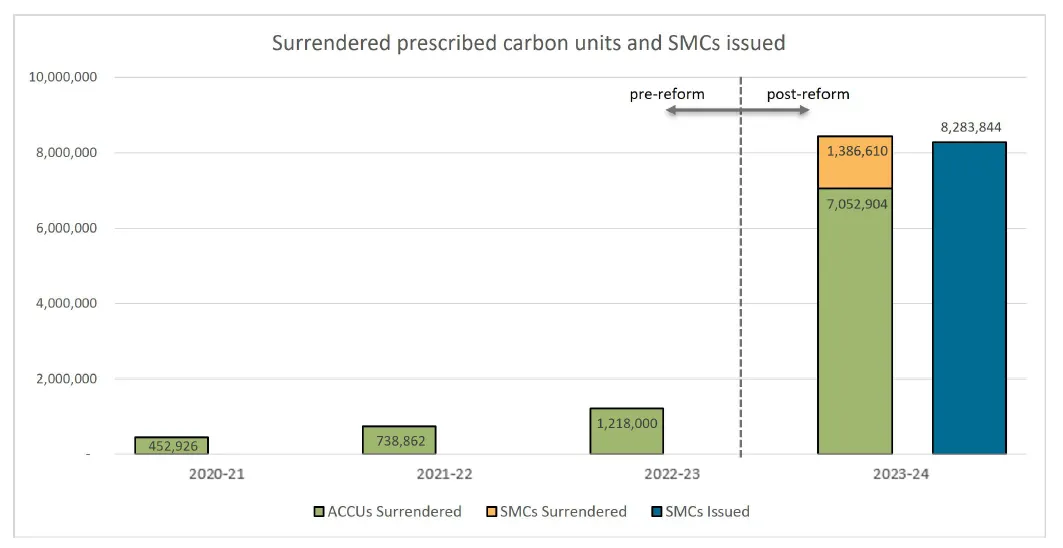
Clean Energy Regulator chart showing carbon credit supply and demand from Safeguard Mechanism. Note there is a lot of ACCU activity both in terms of supply and demand outside of the Safeguard Mechanism e.g. voluntary offsetting.
We can convert these figures into tangible dollar terms. Using the average ACCU price of $33, emitters spent $233m retiring ACCUs and $46m on SMCs, making a total of $279m. But crucially the industry also generated $273m worth of credits for future use. This isn’t a tax but a revenue flow between those companies which are cutting emissions effectively and those which aren’t. One could argue, that the net cost to emitters that year was only about six million dollars.
So how did the authors jump to $1.7bn per year? They rely on a high ACCU price assumption, but even that falls short. They point to annual baseline cuts leading to more facilities being captured, but ignore the growing stockpile of SMCs for future use. The claim feels alarmist and lacks solid backing.
Flawed assumptions on ACCU and SMC ratios
Another key assumption states:
The ratio of ACCUs to SMCs surrendered is assumed to remain the same from 2023-24 to 2029-30.
This is difficult to justify given the stockpiles of SMCs that are accumulating, which will likely disrupt that balance and impact how emissions are managed over time.
In other words, as more SMCs are banked, facilities may rely less on purchasing ACCUs, changing the demand behaviour and overall effectiveness of the scheme.
Where the money really goes
It’s important to understand the different financial flows involved. When emitters buy SMCs the money flows from one emitter that is not compliant to another emitter that is.
When they buy ACCUs, the money flows to farmers and land-owners who generate the credits through land-based activities that are typically beneficial to farming productivity and land restoration. So this is just a transfer between emitters and landholders.
This means the money stays within the private sector, supporting sustainable practices, rather than acting as a tax or government revenue. In effect, this system incentivises real environmental improvements by directly rewarding those who actively reduce carbon emissions.
How export markets are impacting Australian producers
What about the countries importing Australian resources? Many are now demanding proof that goods are carbon neutral. The EU, Australia’s second-largest trading partner for iron ore, aluminium and fertilisers, launched its Carbon Border Adjustment Mechanism (CBAM) in October 2023, on a transitional basis, and plans to implement it fully by 2026.
Under CBAM, importers of emissions-heavy products - such as iron and steel, aluminium, cement, fertilisers, hydrogen and electricity - must buy certificates matching the embedded CO₂ in those goods. This effectively penalises high-carbon supply chains and incentivises exporters, including Australian producers, to adopt “carbon-neutral” practices.
This could mean that Australian producers that fail to cut emissions may face higher costs or lose competitiveness in key markets.
Debunking the IPA’s claims: Understanding the Safeguard Mechanism and its real impact
The IPAs recent critique of Australia’s Safeguard Mechanism mis-labels it a costly carbon tax imposing $1.7 billion annually by 2030. In reality, many emitters consistently beat their targets and earn tradable credits, meaning the system is more a market of transfers than a tax.
Its cost projections rely on questionable assumptions, such as fixed ACCU-to-SMC ratios, despite growing SMC stockpiles that could change how emissions are managed. To understand the financial impact, it’s important to consider where the money actually goes. Unlike a tax, when ACCUs are purchased, the money goes to farmers and landholders running land-based projects, not to the government.
Meanwhile, export markets like the EU are tightening carbon rules through mechanisms such as CBAM, pushing Australian producers toward genuine carbon-neutral practices in order to remain competitive. Schemes like the Safeguard Mechanism aren’t just compliance tools, they’re a competitive necessity. For Australian producers, that means cutting emissions or buying offsets to keep exporting to countries where carbon rules are fast becoming trade barriers.
References
Want to know more?
Read more about Australia’s carbon neutral scheme in Carbon credits that deliver: rebuilding trust in net zero
Carbon Eyes | ACCU Market Intelligence
Strategic data and integrity signals for the Australian carbon market.
1. Carbon Data Platform
The Foundation of Market Transparency | Access the Platform
A comprehensive view of the ACCU landscape. Access structured CER data, project status and issuance trends. Use our core mapping and analytics to establish your market baseline.
2. Integrity & Market Intelligence
Independent Ratings & Supply Forecasts | Upgrade Your Intelligence
Mitigate risk with our paid intelligence layer. Accessed directly within the Platform, these add-ons provide independent ACCU project ratings and forward looking supply forecasts to guide procurement and investment.
3. Land & Asset Decisioning
Identify the Best Opportunities for Carbon Projects
Carbon Potential Report | View Carbon Potential Report (by address)
Instant, address-based viability assessments for lenders and investors.
Carbon Land Search | Identify & Assess High-Potential Assets
Our premium search engine for institutional funds. Identify and de-risk high-potential carbon assets before acquisition.