
1 farm, 12 separate soil projects: Why would landowners do this?
Why farms are split into multiple soil carbon projects
There’s a growing trend to register multiple soil carbon projects on one farm. Clear reasons include managing risk, audits, land sales, and ACCU credit ownership.
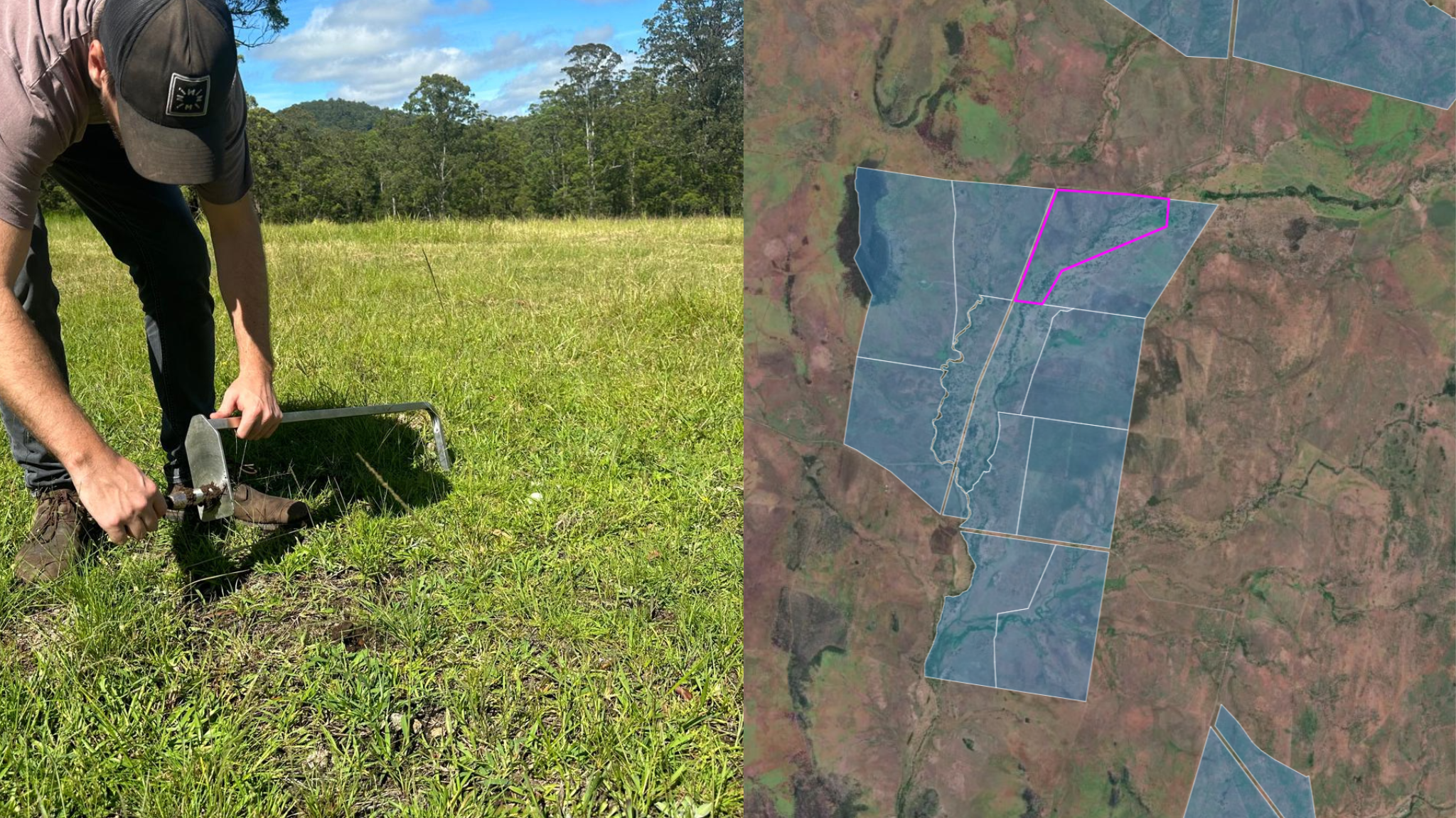
Some landowners are now registering multiple soil carbon projects on a single farm. It might seem unusual at first, but there are good reasons for doing this, such as managing risk, planning for land sales, and audit and compliance.
➡️Managing risk
Soil carbon projects rely on measuring changes in soil organic carbon (SOC) across a farm. If one part underperforms, only that project is affected. This means you’re not averaging results over the whole property, which could hide variability or reduce overall credits. Separate projects let you manage each area more precisely.
➡️Planning for land sales
Many farms span multiple titles. If you sell one title that has its own project, you can transfer the project proponent role and ACCU rights along with it, rather than carving a piece out of a large project. This simplifies future transactions and makes projects more flexible for your long-term plans.
➡️ Audit and compliance
Every soil carbon project needs its own audit report, land management plan, sampling plan, and offset report. Public numbers suggest audits run $15-30k per project. While multiple projects increase the number of reports, there are efficiencies:
Bundled site visits
Shared project management
Common sampling plans and data systems
Even with efficiencies, costs will be higher than a single project, so it’s worth weighing the trade-off between risk management and audit expense.
Splitting a farm into multiple soil carbon projects reduces performance risk and improves flexibility for future land sales. Landowners, can expect high costs due to having to audit and reporting on each project, however this can be partly offset by bundling efficiencies such as site visits, sampling plans and project management.
Real Examples: Beddall Carbon Project
Roundstone, Central QLD
“Moura region is characterised by a sub-tropical, semi-arid climate with an average annual rainfall of approximately 600mm, falling predominantly in the summer months. The Project uses practices including modifying grazing intensity and duration, and introducing legumes to pasture to increase SOC.”
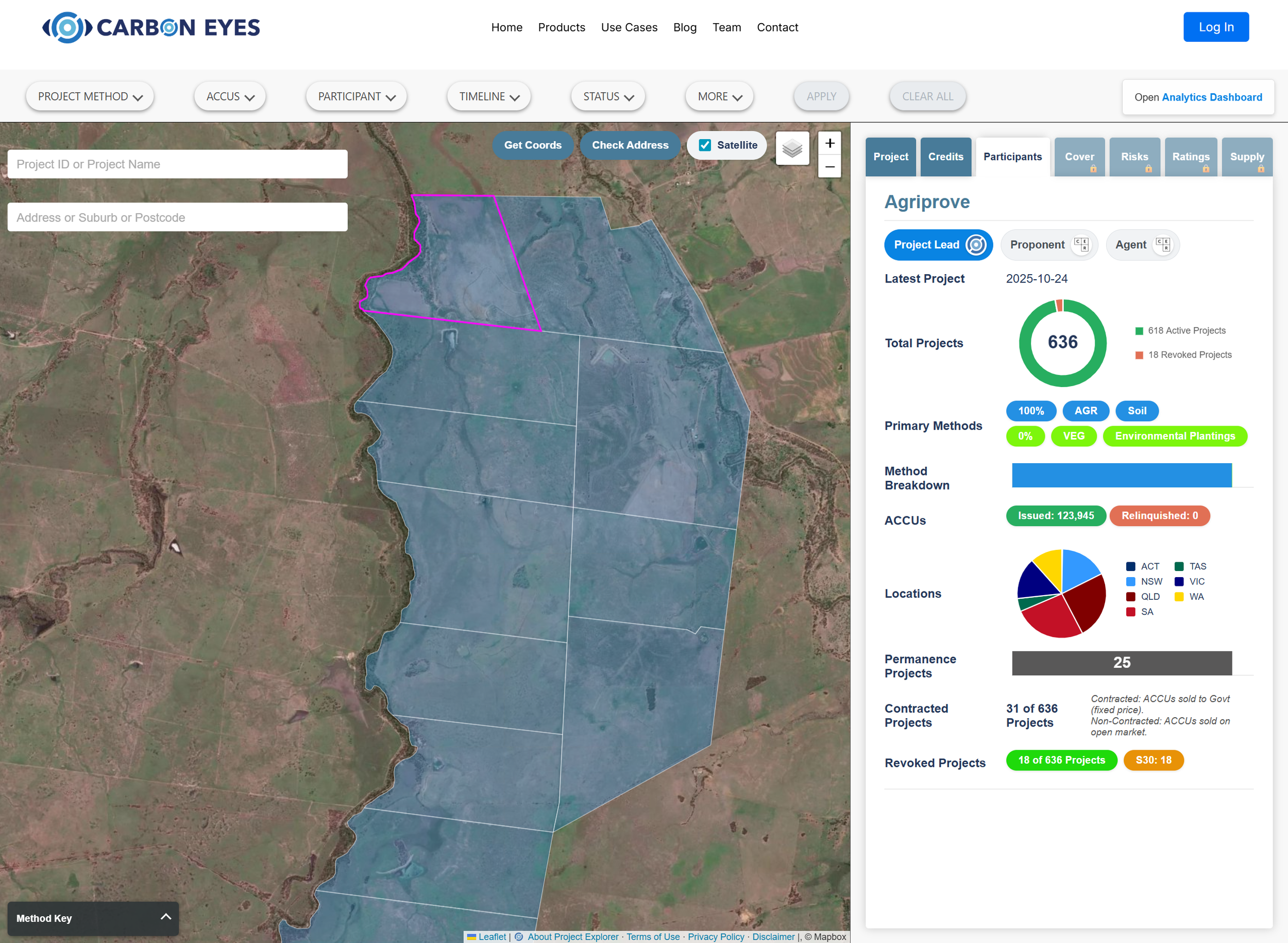
Bendall Carbon Project with proponent Agriprove: Project Explorer | Project Info
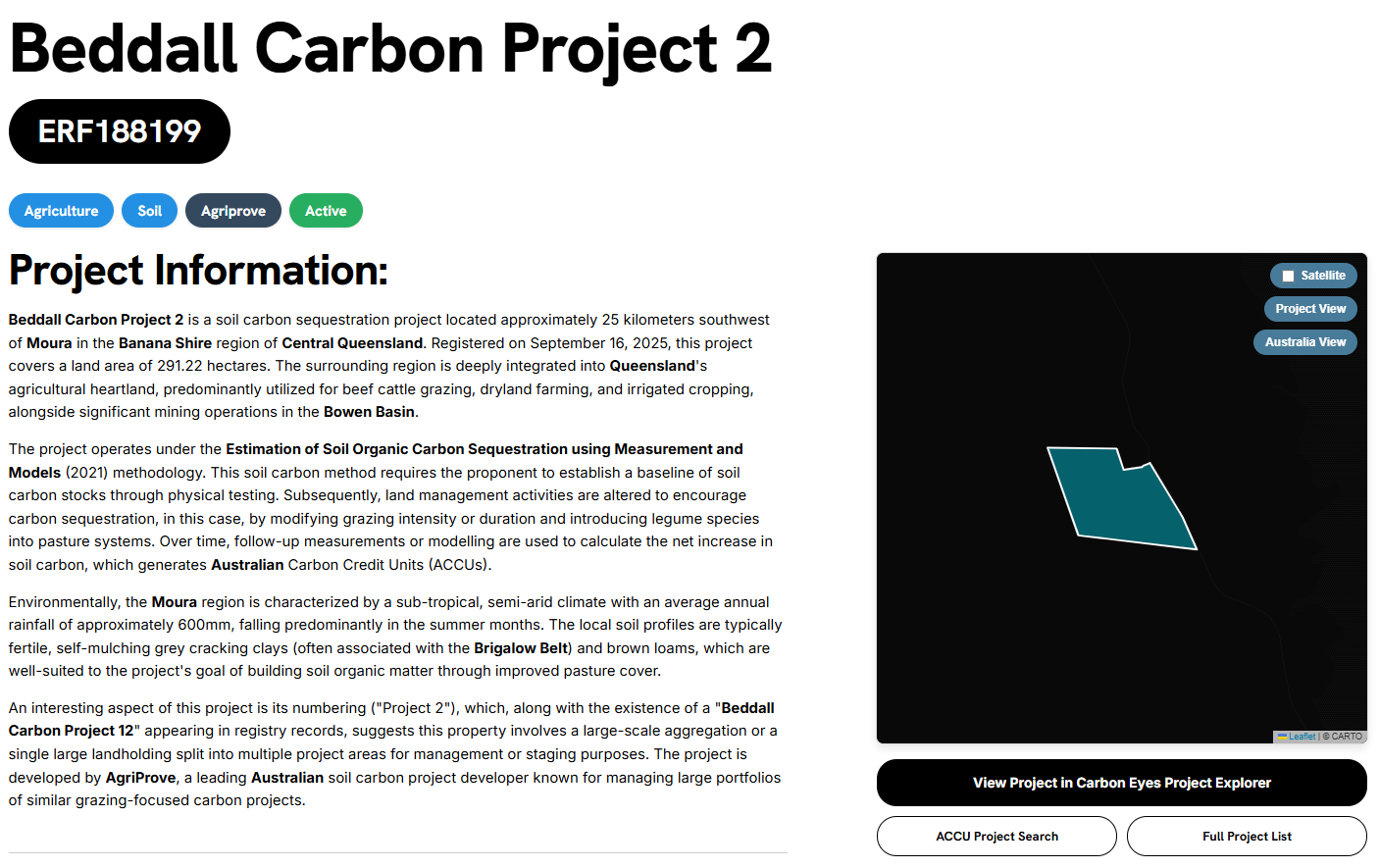
Access a level of detail beyond the standard registry, including project-specific documentation and technical reference links in one place.
A 12-project aggregation across a total farming enterprise of ~2,500 ha with total registered carbon area: 1,114 ha (this covers around half of the total property).
~25km southwest of Moura, a region is characterised by a sub-tropical, semi-arid climate with an average annual rainfall of approximately 600mm, falling predominantly in the summer months.
Registered Sept 2025, soil carbon method: Estimation of Soil Organic Carbon Sequestration using Measurement and Models (2021).
Managed by AgriProve, but land remains owned by the property owner.
Large property split into multiple project areas for staging and risk management.
Practices include rotational grazing and introducing legumes to pasture.
Real Examples: Howson Carbon Project
Tarramba, Central QLD
“Environmental conditions in the Banana Shire are characterized by a semi-arid to subtropical climate. The project uses rotational grazing, improved water infrastructure and pasture rejuvenation used to increase SOC.”
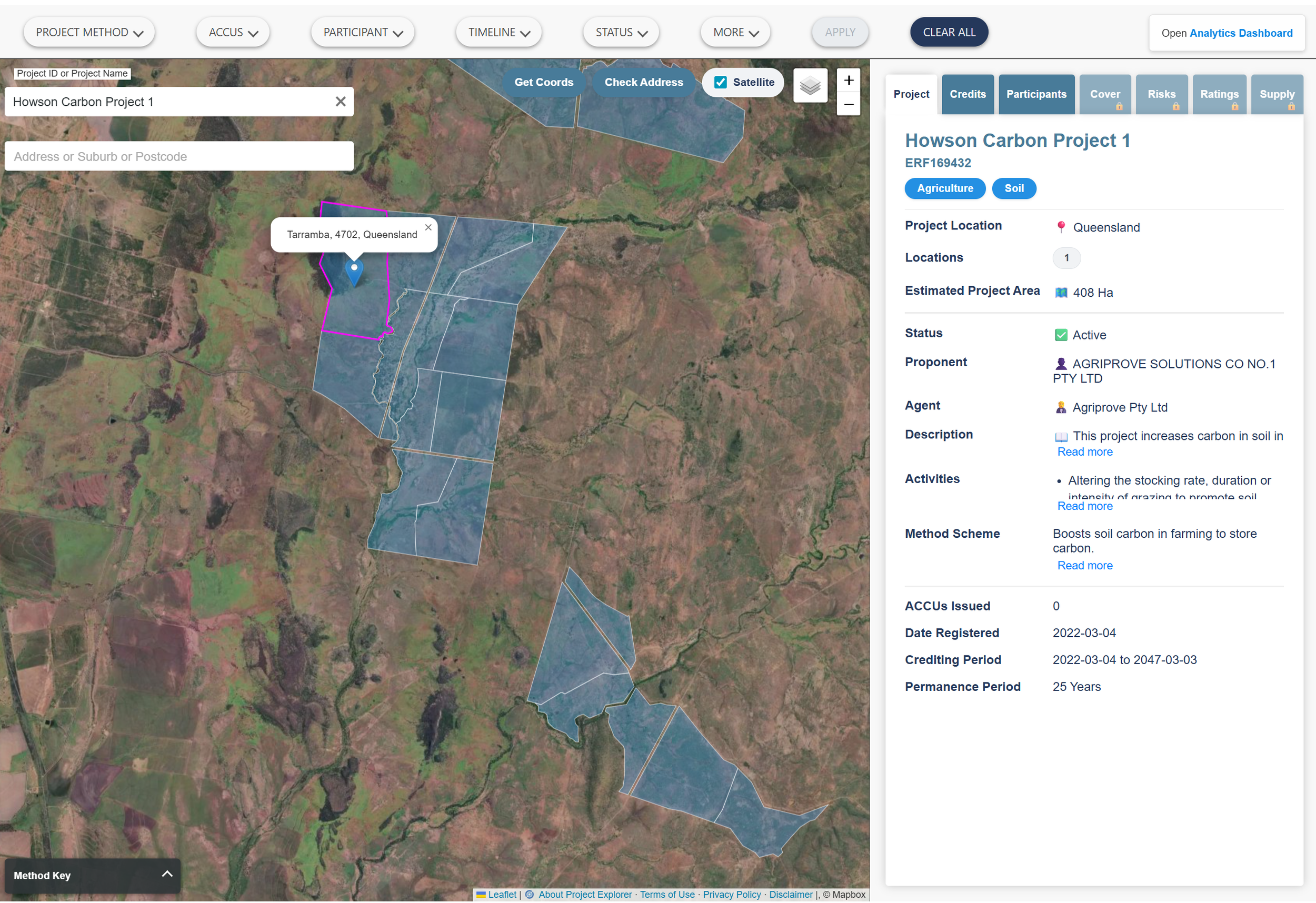
Howson Carbon Project showing one of the project details: Project Explorer | Project Info
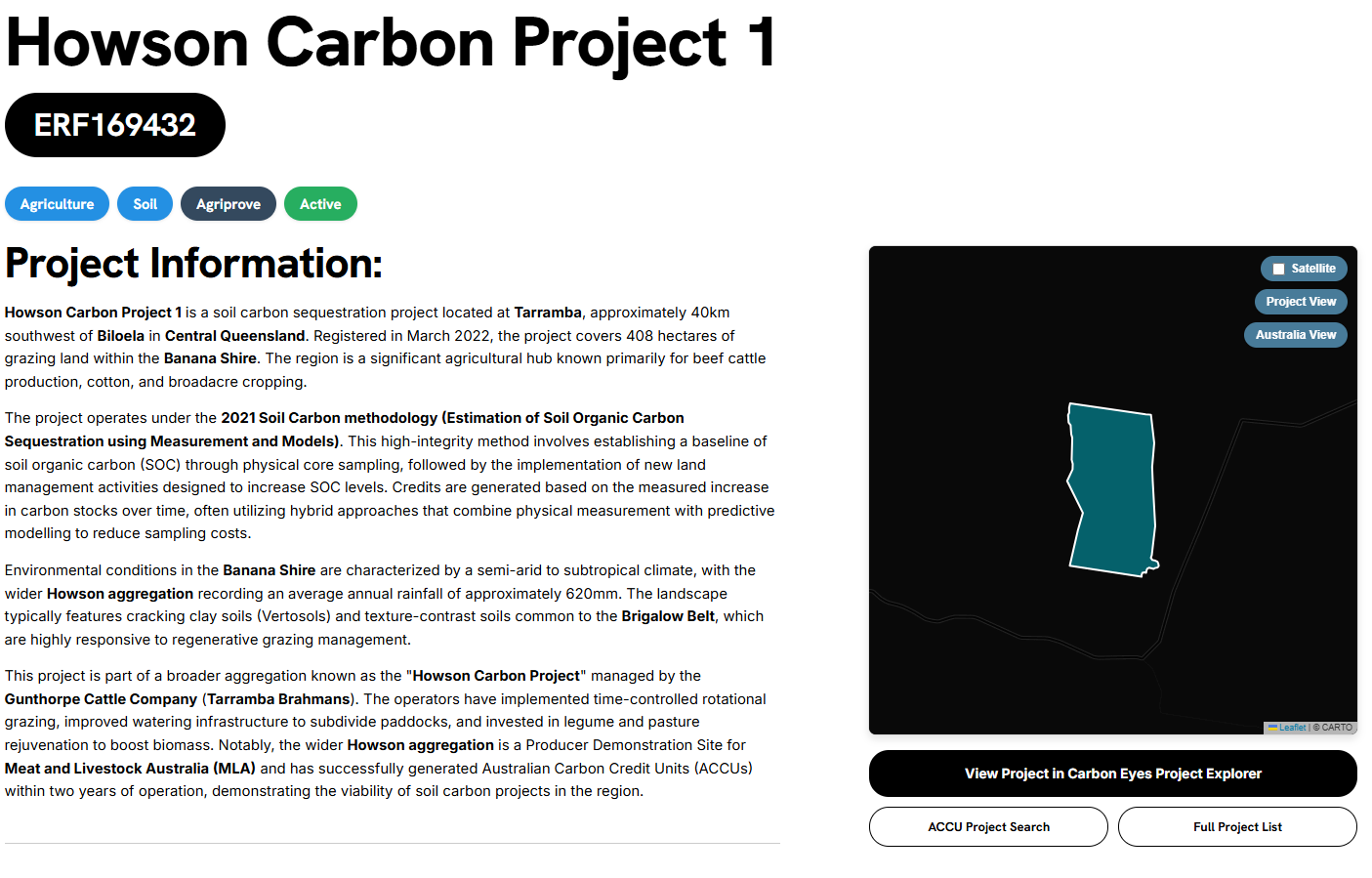
Get more background documentation of an ACCU project with full references.
A 15-project aggregation across a total farming enterprise of ~8,000 ha with total registered carbon area: 1,495 ha (this covers around one fifth of the total property).
Registered March 2022, same 2021 soil carbon methodology
Run by the Gunthorpe Cattle Company, a family-owned grazing enterprise.
The landscape typically features cracking clay soils (Vertosols) and texture-contrast soils common to the Brigalow Belt, which are highly responsive to regenerative grazing management.
Rotational grazing, improved water infrastructure and pasture rejuvenation used to increase SOC.
Successfully generated 8,600 ACCUs within two years (projects 4 and 7), rather than the typical 5 year cycle.
Also acts as a producer demonstration site for Meat and Livestock Australia
Real Examples: Swartz Carbon Project
Morinish, Central QLD
“The project involves a significant transition from set stocking to high-density rotational grazing to increase SOC. To facilitate intensive pasture rest periods, the project implemented 75km of electric fencing and installed 56 new water points.”
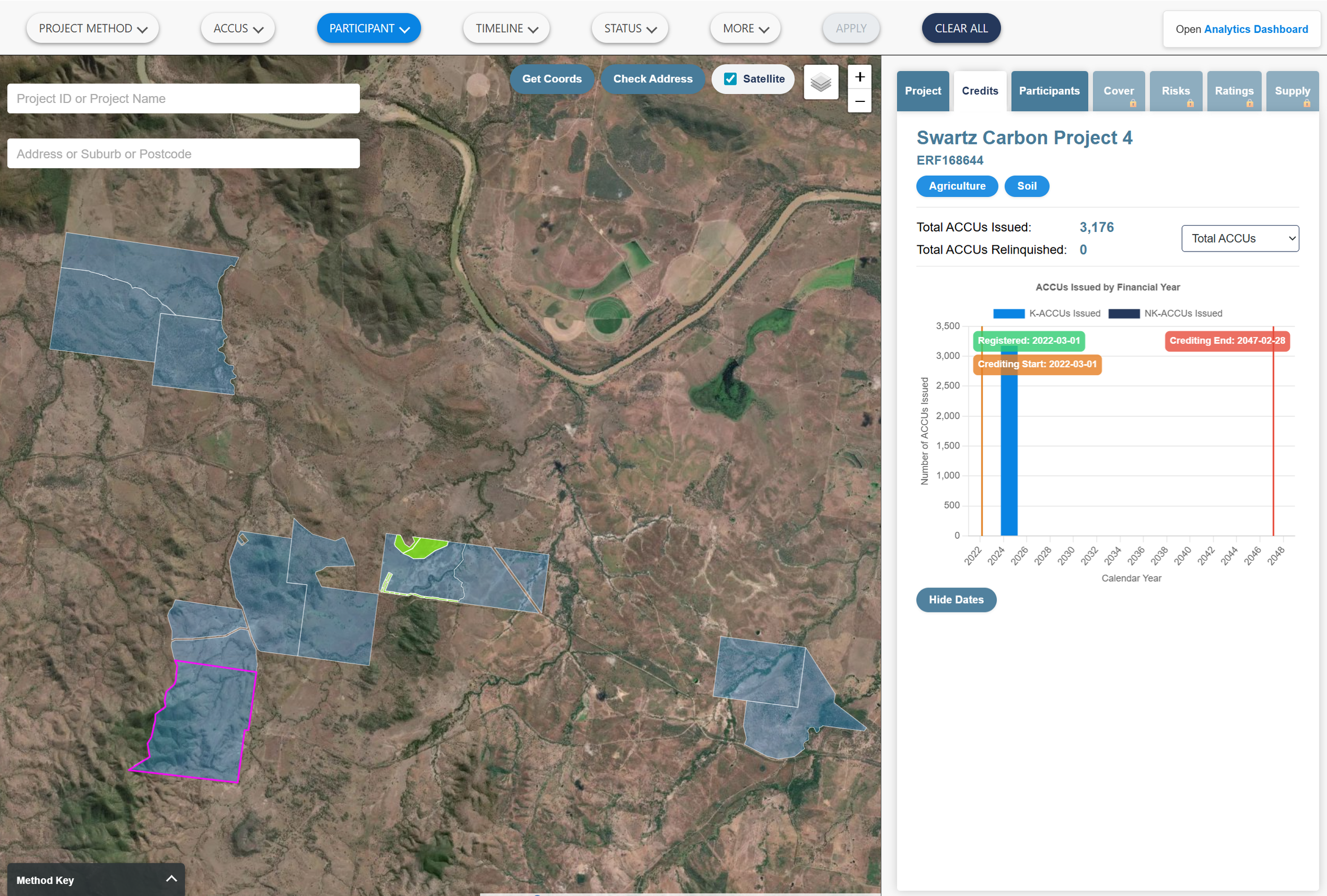
Swartz Carbon Project credits earned for Project 4: Project Explorer | Project Info
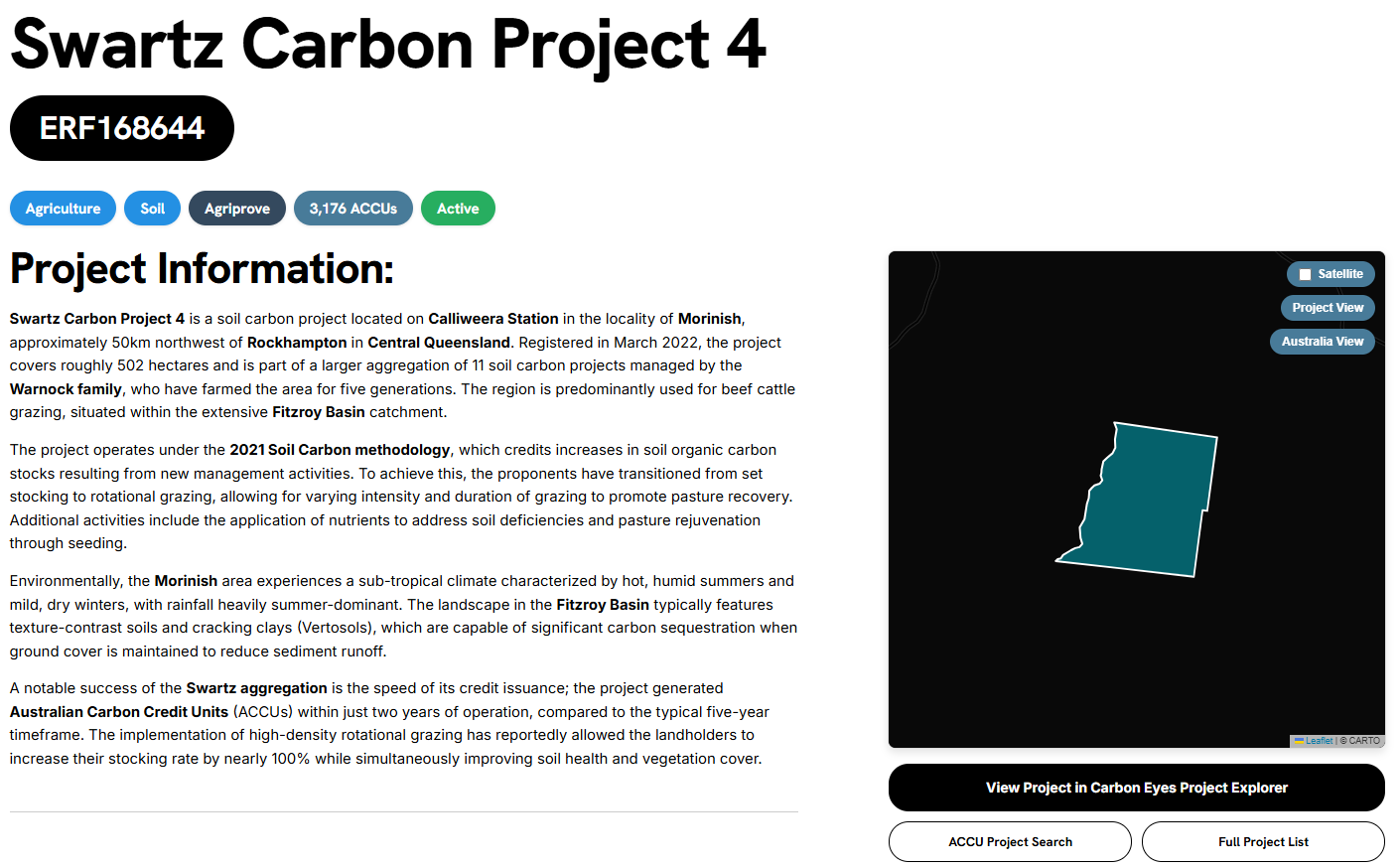
Explore project-specific links and source materials that aren't available in standard public listings.
An 11-project aggregation across a total farming enterprise of ~4,000 ha with total registered carbon area: 2,109 ha (this covers just over half of the property).
Located in the Fitzroy Basin near Gogango (65km SW of Rockhampton), the project area features cracking clay soils (Vertosols) characteristic of the Brigalow Belt.
Managed by the Warnock family, who have farmed the area for five generations.
The project involves a shift from traditional set stocking to high-density rotational grazing, which has reportedly allowed the operators to double their stocking rates.
To facilitate intensive pasture rest periods, the project implemented 75 kms of electric fencing and installed 56 new water points.
Among the first under the 2021 methodology to generate 6,152 ACCUs within two years (projects 4 and 9).
Credit issuance was accelerated through a hybrid verification approach that combines physical soil sampling with advanced satellite modeling.
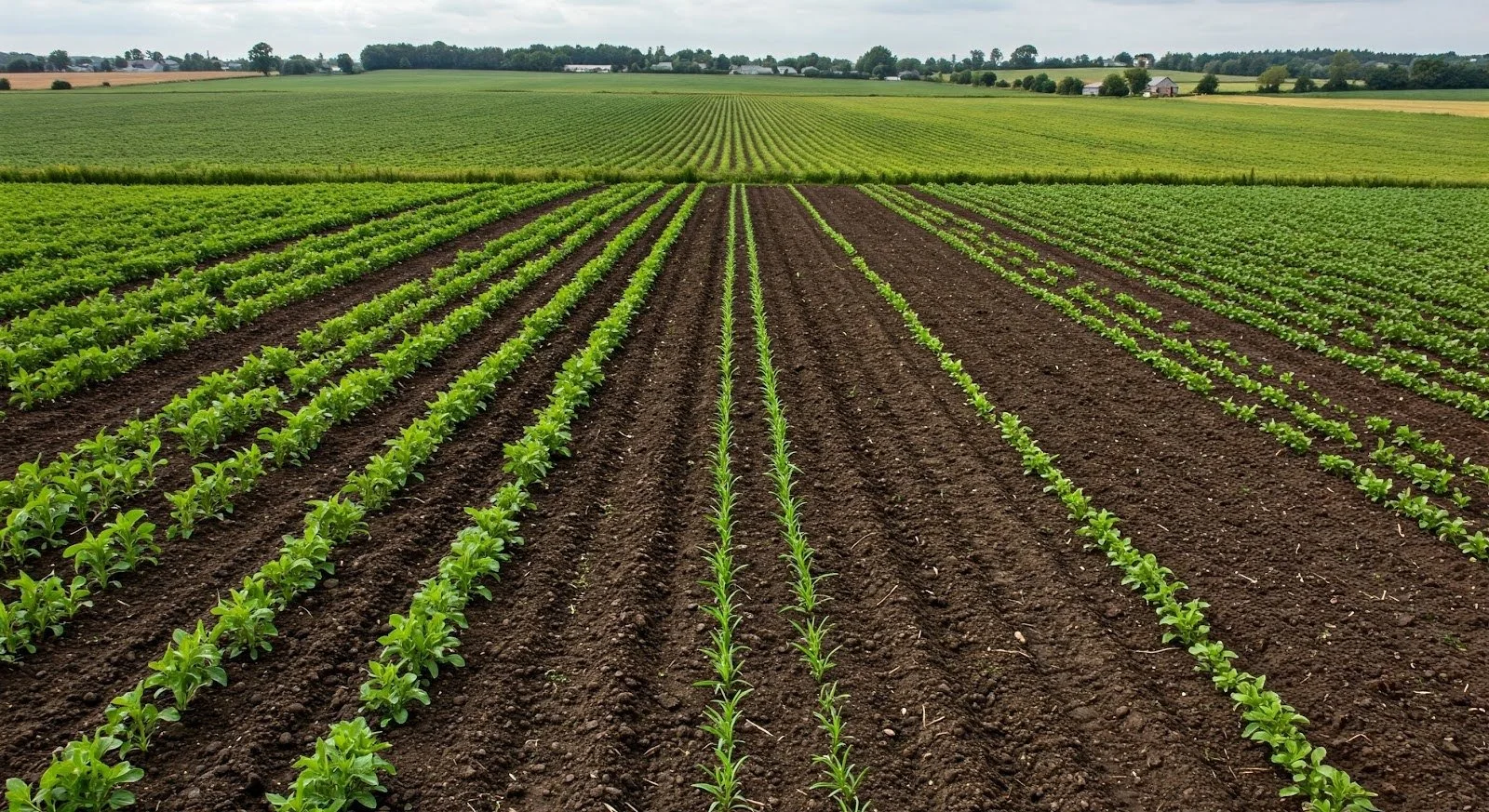
Working with an experienced project developer for soil projects can simplify administration and help you maximise credits
Understanding ownership
For most AgriProve projects:
Land remains with the farmer
AgriProve acts as the project proponent, handling compliance, sampling, and audits
Farmers receive most of the ACCU credits (often ~75%), while AgriProve takes a success fee
This structure ensures:
Long-term commitment from the landowner
Clear legal separation between landownership and project compliance
Projects can transfer more easily if part of the property is sold
Why this matters for landowners
If you’re considering soil carbon projects:
Multiple projects can reduce risk and make future sales simpler
Audits and compliance are required for each project, but efficiencies exist
Working with an experienced project developer can simplify administration and help you maximise credits
Ownership remains with you, the landholder, while still benefiting from professional management
For landowners, understanding project structure, audit requirements, and the ownership model is as important as the potential ACCU revenue. It lets you make informed decisions about which parts of your farm to include, how to manage them, and what to expect from ongoing compliance.
Want read more about carbon soil projects, check out: From paddocks to payments: Soil carbon in practice taking a look at some case studies where farmers are building better soil, one project at a time.
References
Beddall Carbon Project
Howson Soil Project
Swartz Carbon Project
Want to know more?
Soil carbon is having a moment and rightly so. For landowners, it’s more than just improving the health of their land, it’s also a measurable, tradable asset: check out Managing soil carbon projects on working farms.
Unlock the Carbon Potential of your land?
Not sure where to start? Get a clear, data-backed measure of your land's carbon potential. From free snapshot reports to deep-dive assessments, we help you determine the best path forward.
Free Carbon Snapshot: Enter your address to see if a carbon project is viable for your land.
Project Explorer: View existing carbon projects and regional activity near you.
Browse the Learning Hub : Explore the full collection of articles at no cost.