
Carbon market insights: September’s key developments
Carbon Eyes In the Loop - here’s what you missed
A round-up of our best posts about the carbon market, filtered and in one place. Reach out to the team for more detailed market analysis and further insights.

September saw a number of developments across the Australian carbon market, most notably the publication of the official review into the Australian Carbon Credit Unit scheme. While it found the scheme to be fundamentally sound, the review report did recommend some targeted improvements, including over project permanence and method development.
The latest register update from the Clean Energy Regulator provided mixed signals about the carbon market, with the second highest credit issuance for 12 months, set against the lowest new registrations since January 2025.
September also saw the Greens call for a 40% reduction in the supply of ACCUs, in order to pressure large polluters to reduce their emissions, rather than buy carbon offsets. Elsewhere in this edition, we look at an environmental planting project which is spread over multiple sites, across four states.
We also compare soil projects in New South Wales and Queensland, with the former having the most projects, while the latter comes out top in most other criteria. Rounding this edition off, we look at the only three projects to earn carbon credits for 15 financial years in a row.
As always, our focus remains on the project data and market signals shaping Australia's carbon market. For more comprehensive market insights and analysis, please get in touch at info@carboneyes.io. See all the latest projects here.
Review of the ACCU Scheme: permanence in the spotlight [02/09/2026]

The latest official review of the ACCU scheme by the Climate Change Authority has found it to be “fundamentally sound”, and not in need of major reforms. The review report does however recommend several targeted improvements, in order for the scheme to stay relevant to Australia’s climate strategy.
The Climate Change Authority’s official review, released on September 1, recommends targeted improvements to the ACCU scheme rather than a major overhaul. The review largely suggests keeping the current course. However 1 recommendation stands out as having a potential project and market impact.
Briefly, the 6 recommendations are:
Assess permanence buffers
Review appropriateness of 25 year permanence projects for compliance
Prioritise public and First Nations benefits in future Government purchasing
Supply more data to inform purchase decisions
Publish a forward view of method development and timelines
Improve method development
The second one stands out: up until now, the scheme and Safeguard Mechanism have treated 25 year ACCUs the same as 100 year ACCUs in terms of compliance.
The review reinforces the importance of policy stability while calling for closer scrutiny of permanence and better information to support carbon market decisions.
Check out the full blog post: Climate Change Authority calls review not major overhaul.
For the Climate Change Authority’s summary of the review’s findings, follow this link. And for the full review report, see this link.
Seeing the wood for the trees [08/09/2026]
Environmental Planting (EP) projects are not necessarily restricted to a single location or single land title holder. Indeed, this project by Greening Australia and Canopy Nature Based Solutions covers over 30 different sites spread across 10 different areas in four states.
ERF207683: To view go to Project Explorer. Use the location pills within the details to navigate to different parts of the project.
Additional sites can be added over time without having to go through all the rigours of a new project registration. Areas added later sacrifice crediting periods that have already passed.
One of the other advantages of doing aggregations like this is that it allows the developer to spread risk within a single project. It also offers landowners potential protection from relinquishment. In other words, they would not have to hand back credits if their portion of the project fails and the developer covers the relinquishment.
However, if an obligation to hand back credits is not met, the Clean Energy Regulator could potentially impose a Carbon Maintenance Obligation over one or more areas of land within the broader aggregated project. This does not necessarily have to be the property where the reversal occurred.
Carbon credit economics: ACCU supply, emissions reduction and the policy trade-off [11/09/2026]
Austalia’s 4th largest political party, The Greens, have suggested measures that they say could reduce future ACCU supply by 40%, arguing that higher carbon credit prices would push large emitters towards more on-site emissions reductions.
But restricting credit supply could also slow land-sector abatement and nature repair. The ACCU scheme and Safeguard Mechanism need to support both industrial decarbonisation and credible carbon projects.
At the same time, however, the party announced its opposition to the Carbon Credits and Other Legislation Amendment (Integrity and Transparency) Bill, and will move to disallow the planned IFLM (Integrated farm and land management) method.
When there's talk of removing 40% of future ACCU supply, it can be beneficial to take a step back, look at the fundamentals and remember the problems that Australia is attempting to tackle:
Atmospheric carbon dioxide is at a three million year high;
The rate at which greenhouse gases are being emitted is much too high;
There are very few pathways to making nature/environmental repair financially feasible.

Image location: Chichester State Forest, NSW
Trying to constrain the supply of carbon credits, in order to raise prices, would slow land sector abatement and associated co-benefits. Perhaps the policy focus should shift away from the supply side, and towards boosting demand for ACCUs.
More on-site abatement does not have to come at the cost of less land sector abatement. The 2026 to 27 review of the Safeguard Mechanism is ongoing, with written public submissions now being considered.
Check out the full blog post: Pressure to limit ACCU supply in Australia.
Further reading: Koala Park coal and gas ban opens new front in climate wars (Australian Financial Review article published on September 10).
Carbon credit issuance for August was the second highest for 12 months [17/09/2026]
The latest monthly register update by the Clean Energy Regulator saw approximately 3.153 million ACCUs shared across 110 projects. During the same update period, only 15 new projects were registered, the lowest monthly figure since January 2025. Meanwhile, six projects were voluntarily revoked, making for a net gain of just nine to the total of active projects. See the latest projects here. For more information about September’s register update, see the latest edition of Carbon Eyes Curiosity.
New registrations
The 15 new projects which were registered in August came from a mix of methods and locations. Plantation forestry and soil organic carbon both had six registrations, while there were two new savanna fire management projects, and one environmental planting project, the lowest since April 2025.
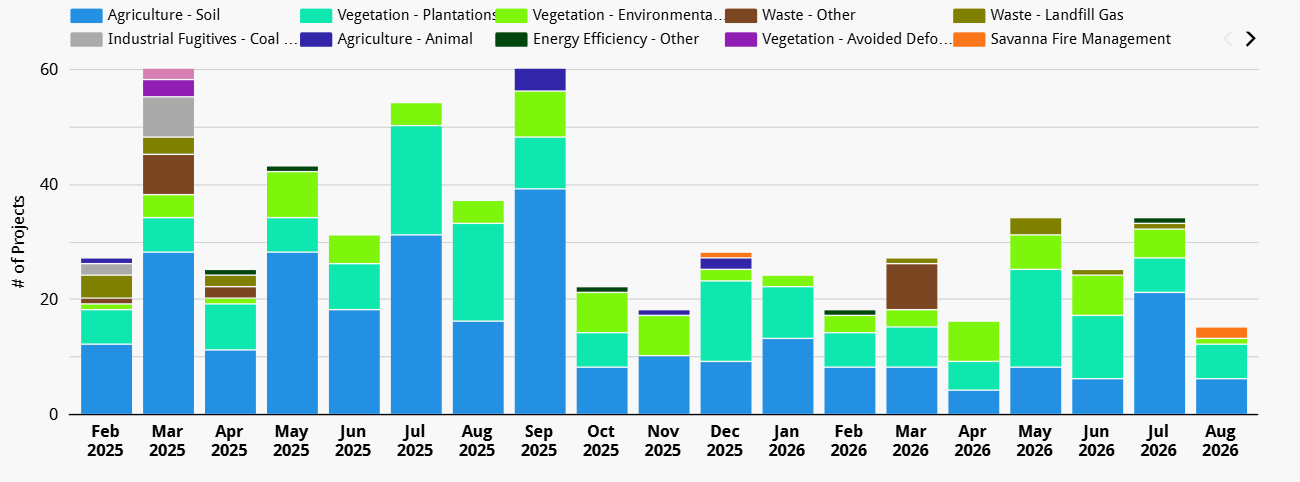
New registrations by month and method
In terms of location, the projects were spread across all six states:
New South Wales (5);
Victoria (4);
Queensland (2);
Western Australia (2);
Tasmania (1);
South Australia (1).
All but two of the projects opted for a 25-year permanence period, with one choosing 100 years (Landari Port Lincoln 2026, ERF209708), and one which did not need a permanence period (Wallar Bayan Carbon Project, ERF210035).
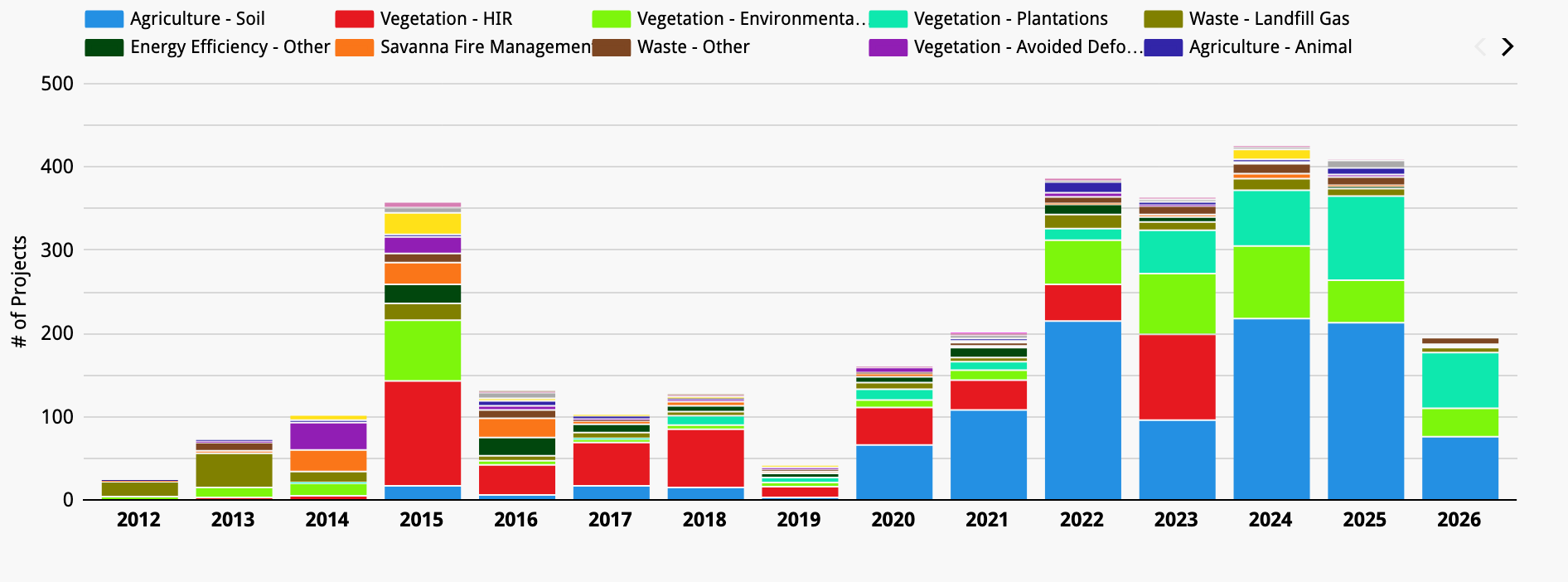
Project registrations by year and method
The net addition of nine projects took the total number of active projects to 2,640. If current trends continue, then 2026 could see the lowest number of ACCU scheme registrations since 2021. The most likely reason for this is the expiry of a number of methods in 2025, while several new ones under development have yet to start taking registrations.
Credits issued
A total of 110 projects earned ACCUs during August, gaining a combined issuance of some 3.153 million credits, the second highest total for 12 months. Of these projects, 99 had been credited at least once before, while for the remaining 11, it was their first ACCUs.
The highest individual award went to Moranbah North Waste Coal Mine Gas Power Station (ERF169184), which earned 356,222 ACCUs in August. At the other end of the scale was Caddigat Restoration Project (ERF195010), which gained its first 267 credits.
The Bulgoo Station Native Forest Protection Project was an interesting case, as it was awarded 232,188 ACCUs, despite its crediting period ending in June 2025. The final issuance was for the sequestration component of the project, in other words, on top of the avoided emissions of vegetation not being removed, the forest grew and accumulated biomass during the crediting period.
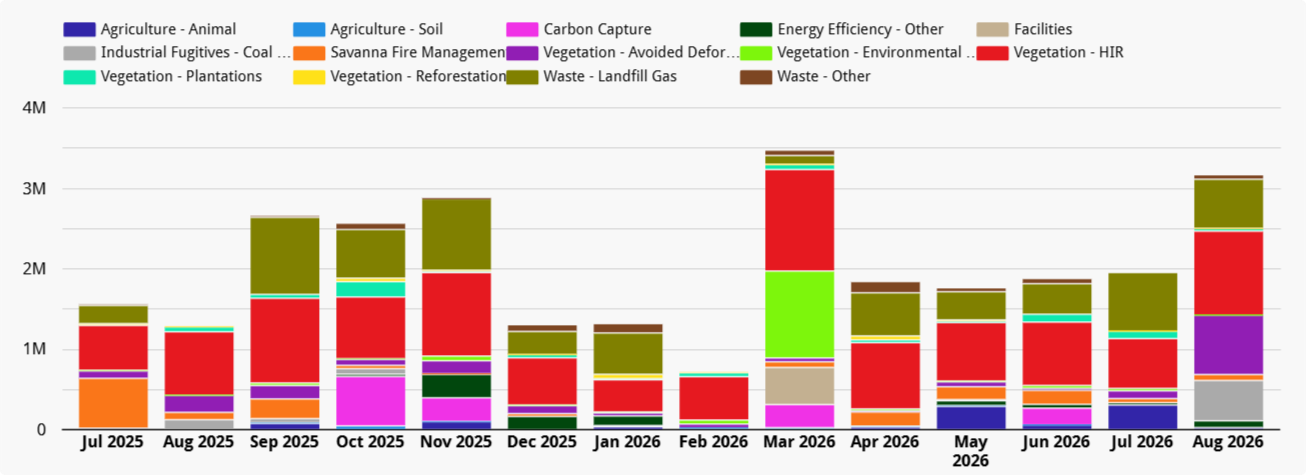
ACCUs by month and method
Vegetation projects (for the most part human-induced regeneration and avoided deforestation, but also plantation forestry and reforestation) dominated issuance, both in terms of the number of projects (63), and total issuance (1,818,495). This was followed by waste - principally landfill gas - with 35 projects, then industrial fugitives (5), energy efficiency (3), savannah fire management (3), and agiculture (1).
The top four methods in terms of issuance were:
Human-induced regeneration (1,042,869 ACCUs/33% of total issuance);
Avoided deforestation (739,922/23%);
Landfill gas (609,564/19%);
Industrial fugitives (501,604/16%).
Overall, these methods gained 2,893,959 credits, just under 92% of total credits issued in August.
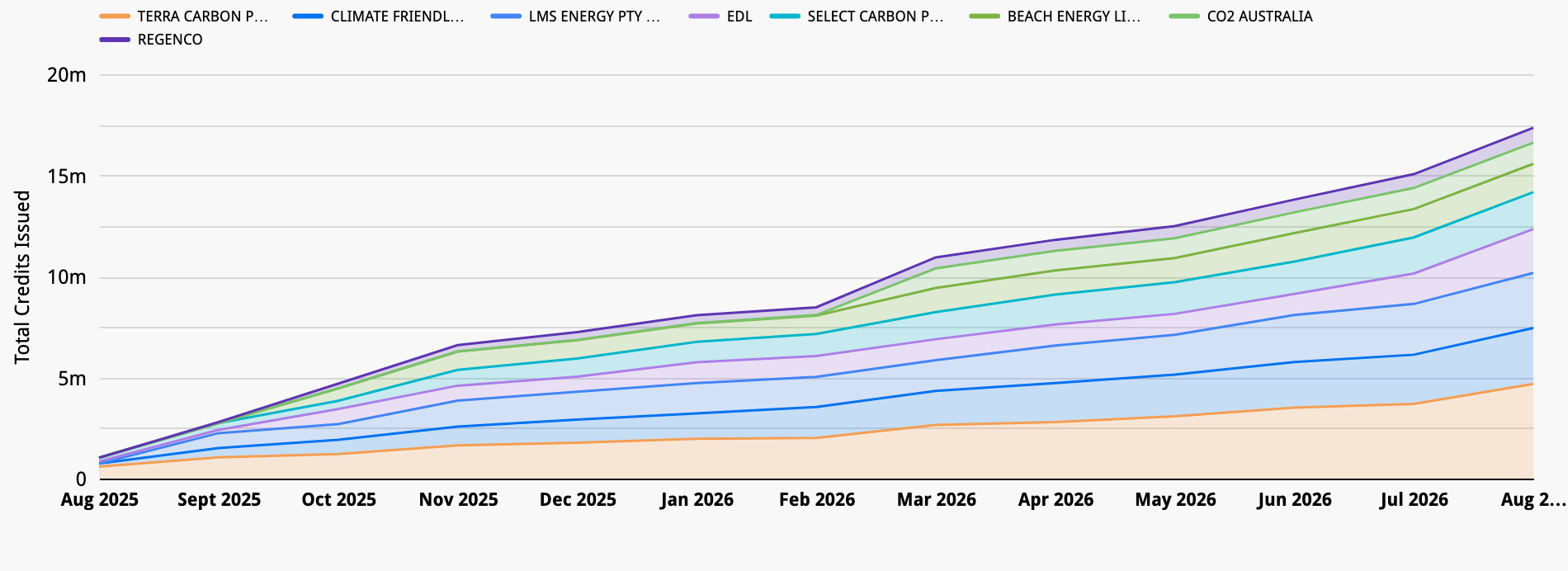
Project lead momentum for credit issuance over the last 12 months
The three most prolific proponents/agents were:
LMS Energy, with 24 landfill gas projects, gained a total of 215,087 credits, taking its tally for the past 12 months to 2,512,116 ACCUs.
TerraCarbon secured credits for 21 vegetation projects, with a combined issuance of 993,247 credits. Its total for the past 12 months stands at 4,687,896 ACCUs.
EDL Energy secured 664,362 credits across eight bio-energy projects, five of them industrial fugitives, and the remainder landfill gas. The latest ACCU’s took EDL’s total issuance over the past 12 months to 2,170,812 credits.
Revoked projects
Six projects were voluntarily revoked in August, all of them under Section 30 of the CFI (Carbon Farming Initiative) Rule 2015. This section is used for projects which have not earned credits.
Five of the revoked projects used the soil organic carbon method, all of them with proponent AgriProve. The remaining revocation was registered under the NFMR (Native forest from managed regrowth) method 2013, with TerraCarbon as its proponent.
To view ACCU statistics and trends head to our Analytics Dashboard and create a free account to access additional pages.
Soil of origin: NSW versus Queensland soil carbon projects [22/09/2026]
In terms of ACCU project registrations, New South Wales leads all other states in Australia with 271 active projects, followed by Queensland with 237.
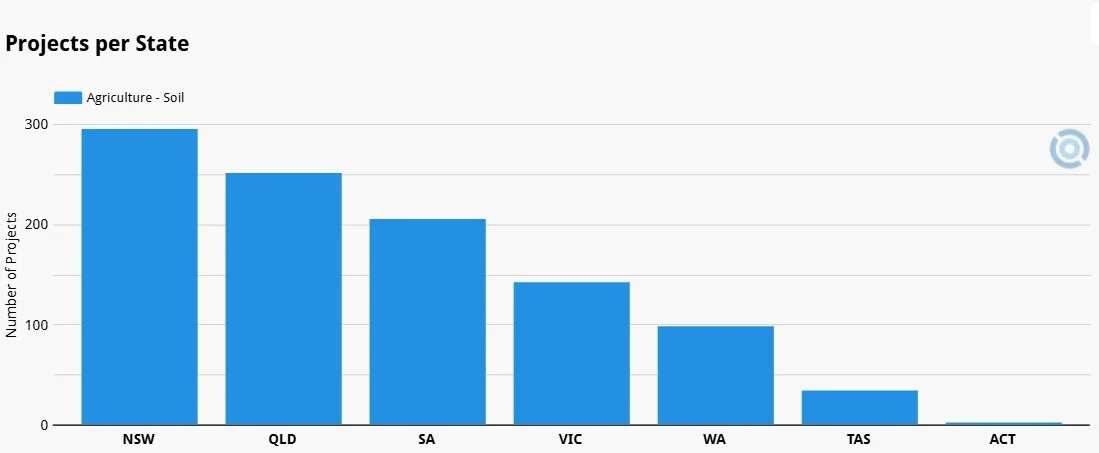
All-time soil project registrations - includes revoked projects
However, Queensland’s projects dominate in several other respects, and also appear to be more efficient at producing carbon credits:
In terms of size, Queensland’s projects cover 437,000 hectares, compared to NSW’s 354,000 hectares;
When it comes to total ACCUs issued, Queensland has roughly 319,000 credits, shared across 20 projects, while New South Wales has 12 projects, which have earned approximately 68,000 ACCUs.

Bonnie Doone Soil Carbon Project: ERF108333: View on Project Explorer (right)
Cheyenne Soil Carbon Project: ERF104527: View on Project Explorer (left)
The soil project with the most credit issuance is the Bonnie Doone Soil Carbon Project in Queensland (right image). Set up by CarbonLink in 2017, it has been awarded 94,666 ACCUs, and covers approximately 5,275 hectares, with a carbon estimation area (CEA) of 3,875 hectares.
The next two most successful projects in terms of issuance - Moora Plains Soil Carbon Project (85,262 credits) and Turpentine Carbon Project (66,050 ACCUs) - are also located in Queensland. Between them, Bonnie Doone, Moora Plains and Turpentine have captured more than half the total amount of ACCUs issued to soil projects. (For more on these three projects, see Soil carbon at scale).
Overall, Queensland has eight of the top 10 credited soil projects, while New South Wales has only one, Cheyenne Soil Carbon Project (left image). On a much smaller project area - 758 hectares, with a CEA of 577 hectares - it has earned 28,859 ACCUs. If we look at credits earned per hectare, Cheyenne has proved more efficient than the Queensland big three.
In comments on LinkeIn, The Carbon Daily, said:
“The issuance gap is striking. It would be interesting to understand how much of the difference comes from project age, methodology, soil conditions and management practices rather than project efficiency alone.”
It is worth noting that of the 957 active soil projects, only 53 have earned credits so far. Time will tell whether the relative success of Queensland over New South Wales will continue as more projects are credited.
The Australian carbon projects with the longest crediting history [29/09/2026]
Only three ACCU projects have been awarded credits every financial year since 2012/13, all of them using the landfill gas method. The projects also share the same proponent - LMS Energy - and are coming to the end of their crediting periods this year.
Darwin Landfill Gas Project captures waste methane and uses it to generate electricity. The facility, which was the first of its kind in Northern Territory, generates enough power for 1,200 local homes. It has been awarded 14,179 ACCUs so far this financial year, taking its total issuance to 613,846 credits.
Mirabooka Landfill Gas Project, which is located about 12km from central Perth, captures and combusts methane from organic waste. This process converts the highly potent gas into carbon dioxide, in order to reduce the overall greenhouse gas effect. Mirabooka has earned a total of 319,578 credits.
Buderim Landfill Gas Project was registered in August 2012, and has since been credited with 91,473 ACCUs. The project, which is located on Queensland’s Sunshine Coast, about 90km north of Brisbane, captures and combusts methane gas from organic waste. Like Darwin and Mirabooka, it has earned credits in 15 consecutive financial years.

EOP100101: View on Project Explorer
EOP100102: View on Project Explorer
EOP100106: View on Project Explorer
There is no requirement under applicable method rules for these projects to continue methane removal activities, after the end of their crediting periods. However, state EPA/environmental licence conditions, may require them to do so.
This raises the additionality question and is one of the primary criticisms of landfill gas projects: if methane would already have been captured and destroyed for regulatory and/or commercial reasons, should that form part of the project baseline, rather than being credited as additional abatement?
To address this, the 2021 landfill gas method introduced detailed procedures for translating state and territory licence conditions into project baselines.
As always, we will continue tracking the underlying project data, register movements and policy developments shaping the Australian carbon market.
For more comprehensive market insights and analysis, please get in touch at info@carboneyes.io.
Join our community to get the latest carbon market intelligence delivered monthly
Want to know more?
If you missed it August had a number of developments across the carbon market: Carbon market insights: close to 2 million credits shared amongst 90 projects.
References
Carbon Eyes ACCU project register and project level analytics
Carbon Eyes market commentary on ACCU project activity and issuance trends
CER (Clean Energy Regulator)
Carbon Eyes | Carbon Market Intelligence
The independent view of Australia's carbon market.
1. Discover projects
Find and shortlist ACCU projects using structured CER data, market information and enriched project and land data. Get notified of project changes.
2. Understand the risks
Assess individual projects using detailed data, risk metrics and independent rating breakdowns, to understand project quality, characteristics and potential risks.
3. Go deeper
Get a detailed independent assessment of an individual project for high value procurement, investment, lending and offtake decisions.